

On Gaelic & some other languages around Scottish Seas, publ. on the 03/08/2026
Written and published by Linden Alexander Pentecost on the 3rd of August 2026; important updates were made on the 4th of August 2026 at 3:10 AM. This publication is unrelated to and separate from any and all of my other publications. Note that the way in which I discuss the topics at hand here is entirely different to, and with different examples and information to, the way in which I have discussed these languages elsewhere, this article also includes discussions on a lot of things, points and examples of new things have never discussed before. I, the author, also took the three photos included in this article, and they also, like the rest of the content, have never been published before. This publication was published in the UK. No AI was used in this publication nor in any of my writings. This article contains 6969 words in total. This article discusses a lot of things, which are discussed between the following main sections, which are titled: On Scottish Gaelic, On some Outer Hebrides Scottish Gaelic dialects, Beurla Reagaird and other indigenous languages on these isles, On the Norn languages, and On the Faroese language. All of these sections contain information about, and examples connected to, and other points connected to the main topics I have never published before, and new information and points, and examples in general about new topics. Note earlier this early morning (on the 4th of August 2026 when the edits were made) I published an unrelated blog post on a different website, wherein I also discuss the word gýgr albeit in a completely different context.
On Scottish Gaelic
Naturally, the most well known indigenous language associated with the Scottish Islands is Scottish Gaelic, and rightly so. Whilst this language was never spoken to a large degree on the Orkney and Shetland Isles, it was spoken at one time across most of what is now Scotland, to some degree or other. In this article I am discussing Gaelic in relation to the Outer Hebrides specifically. The Scottish Gaelic language originally possessed a high degree of dialectal diversity, at least in certain respects, although in the present time, most of the original dialects are either extinct or critically endangered. Many dialects do still survive to some degree however, although they are not (in my opinion) so accessible to learners, with the standard forms of Gaelic, as written and taught anyway, often being a form of compromise, and sometimes obscuring original pronunciations and variations.
The Gaelic dialects of Skye and the Outer Hebrides have remained as community languages to the highest degree. Whilst the Skye Gaelic dialects often fit the standard spelling quite well, the same is not I think true for the Outer Hebridean dialects, and so without variations in spelling it can be very difficult and inaccessible to understand the full scope of how these dialects differ, and how Gaelic dialects in general differ from each other. The IPA is useful for showing pronunciation, but it do not see it as becoming the personal means through which these dialects can realistically be expressed as community languages in their written form, and so I think dialect spellings can help with this, in my opinion.
Standard Gaelic spelling, with some variant word forms, can represent the dialects too, but only to a limited degree. It depends on how accurate one wants to represent the phonology, and it depends on the question of how important, and/or endangered are certain sounds and features, that might require inclusion in spelling? I remember hearing something said once, that in order to learn Gaelic dialects, one has to learn the standard language first. And sadly, to a large degree this is true. But I do not think that this should have to be the case, and I believe that focusing on teaching and reviving Gaelic on a local level, from the perspective of the dialect, and not from that of the standard language, will help to revive Gaelic in many areas, first and foremost because the focus upon the local dialect exemplifies the more intimate connection between the people of that place, and their historic form of speech that was used to relate to that place. This can in many senses be more meaningful than the idea of Gaelic as a standard Scottish language.
The following sentences I wrote, will I hope help to demonstrate something on how Gaelic sentence structure, and structure in general works, and differs significantly from that of English.
- Chì sinn an eunlaith ag itealaich anns an adhar - “we see (will see) the birds flying in the sky”. Broken down this means chì - future tense form of faic - “to see”, sinn - “we”, an eunlaith - “the birds”, an - form of definite article, eunlaith - birds, a collective noun, ag - “in the process of” (before vowels), itealaich - “flying”, verb-noun of itealaich - “to fly”, , anns an adhar - “in the sky”, anns an - “in the” (roughly meaning), an adhar - prepositional form of an t-adhar - “the sky” (nominative form).
- Tha eachdraidh na h-Alba glé inntinneach, nam bheachd-sa - “the history of Scotland is very interesting, in my opinion”. This can be broken down as: tha - “is/are/there is/there are”, eachdraidh - “history”, Alba - “Scotland”, eachdraidh na h-Alba - “history of Scotland”, glé - “very”, inntinneach - “interesting”, beachd - “opinion” or “idea”, nam bheachd - “in my opinion”, -sa - emphatic suffix to indicate “self”, so nam bheachd-sa - emphases that the opinion is my own self(s).
- Bidh mi a’ coiseachadh air a’ chladach gach madainn - “I will be walking every morning on the shore”; this can be broken down as: bidh - “there will be/will be”, future form of bi - “to be”, mi – “me”, a’ - “in the process of”, coiseachadh - “walking”, verb-noun form of coisich - “to walk”, air a’ chladach - “on the shore, from air - “on”, plus the prepositional form of an cladach - “the shore”, thus air a’ chladach - “on the shore”, gach - “every, each”, madainn - “morning”.
- Cha robh sinn a’ leughadh móran leabhraichean anns an taigh againn - “we were not reading many books in our house”; which can be broken down as cha - negative particle, robh - affirmative interrogative past form of bi - “to be”, also used after the negative particle cha, sinn - “we”, a’ - in the process of, leughadh - “reading”, verb-noun form of leugh - “to read”, móran - “many” or “a lot of”, leabhraichean - “books”, nominative plural of leabhar - “book”, anns an - “in the”, taigh - “house”, againn - “at us”, thus anns an taigh againn - “in our house”.
- Bha iad a’ seòladh dhachaidh anns’ a bhàta mhór - “they were sailing home in the big boat”; which can be broken down as bha - “was/were/there was/there were”, past tense form of bi, iad - “they”, a’ - “in the process of”, seòladh - “sailing”, verb-noun form of seòl - “to sail”, also meaning “a sail”, dhachaidh - “home”, anns a’ bhàta - “in the boat”, from the nominative definite form am bàta - “the boat”, with a’ bhàta mhór being the prepositional form of am bàta mór - “the big boat”.
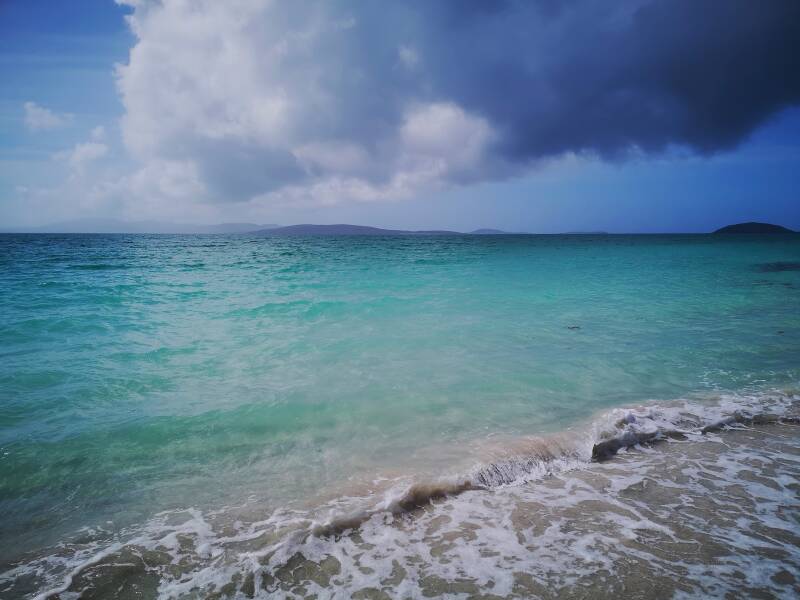
Photo below: the Sound of Barra taken from the island of Eriskay, Eirisgeidh, the photo below is quite close to a photo I published elsewhere, but the two photos are not the same. The area visible towards the right of this photo contains several islands, and in the distant past, I think it likely that much of the sea between them would have been land. The area between Eriskay and Barra also represents an important dialectal divide, and sadly there is very little information about the Gaelic dialects once spoken on those now uninhabited islands in the Sound of Barra.
On some Outer Hebrides Scottish Gaelic dialects
- Barra dialects: the Barra dialects have a unique prosody and musical intonation which differs from that of other dialects, furthermore, there are a number of important differences in grammar, vocabulary and phonology, although Barra Gaelic remains largely mutually intelligible to speakers of other Outer Hebridean dialects. I have discussed much more on Barra Gaelic elsewhere, and on many of the other Outer Hebridean dialects.
- Eriskay dialects: Eriskay dialects differ from those on Barra, to my knowledge, in the absence of the đ sound (a sound close to the English "j" in "joy" but articulated closer to being a palatal r - this sound on Barra replaces the slender r of many other dialects), with the “slender r” on Eriskay typically being a variant of the more general Scottish Gaelic slender r, for example in the words muir - “sea”, and . Unlike Barra Gaelic, Eriskay Gaelic occasionally has a broad velarised L followed by a w for the broad velarised L sound, which is generally more common in Argyll Gaelic dialects, but also occurs on Harris, and sporadically in parts of eastern Scotland and elsewhere, including in some words on South Uist.
- South Uist dialects: South Uist dialects can be very distinct from other Outer Hebridean dialects in terms of their prosody or rhythm, something which I have discussed elsewhere. On the level of phonemes, South Uist Gaelic contains fewer distinctions than Barra Gaelic. Below are four examples of South Uist Gaelic vocabulary (written in standard Gaelic spelling), with explanations and comments after each word:
I. beairt - meaning a "fishing tackle", “fishing line” or "loom" on South Uist, elsewhere meaning a “loom” or “plough” among other things, the “fishing line” meaning seems to be found in a few places other than South Uist too.II. dùrd - meaning a “word” or "syllable" on South Uist, in other dialects this word tends to more generally mean a “syllable” or a “hum” or some kind of indistinct sound. It is tempting to see a relationship between this word and the Old West Norse word orð - “a word”, English “word”, Lithuanian vardas - “name” etc, although it is also possible that this word is connected to Gaelic thuirt or duirt - “said”, although I find the latter possibility less likely.
The Proto-Uralic root: *lOlkV, was reconstructed by Sergei Starostin, and can be viewed on the starling.rinet.ru website.
III. cnap - a “shoal of fish”, in other dialects, this word tends to mean a “mass of”, a “lump of” or “large amount of” something, or a gust of wind, or a “thud” among other meanings. It is interesting that in South Uist Gaelic, the word seems to specifically refer to a large amount of, or more specifically, to a shoal of fish here.
IV. lorc - a South Uist Gaelic word I have discussed in another way elsewhere, it means “a hand” or "stout stick". In other dialect. In other dialects, what seem to be variants of this word pop up, meaning “foot”, or “staff” or “wrinkle”. I have postulated before that this word (or rather the specific “hand” meaning of it) could connect to Proto-Uralic *lOlkV, meaning a “foot”, “paw” or “hand”, which makes sense given some of the semantic meanings in Gaelic. As I discussed elsewhere, another South Uist Gaelic word might also be connected.
The four words given above were sourced from the book: Gaelic Words and Expressions from South Uist and Eriskay, by Rev. Fr. Allan MacDonald, I noted these particular words back in 2011 when I was first on Barra, I have discussed many others from South Uist elsewhere.
Below is a table of words, showing English, standard Gaelic, and their equivalents across various Outer Hebridean Gaelic dialects.
| English | Standard Gaelic spelling | Barra Gaelic | Eriskay Gaelic | South Uist Gaelic | St Kilda Gaelic | North Lewis Gaelic |
|---|---|---|---|---|---|---|
| The name "Màiri" | Màiri | Màiđi | Mæ̀iri | Màiri, Màiði | Màili | Mæ̀iði |
| "a giant" | famhair | fuaȧiđo̊ | fʊ̰a̰airi | fʊ̰a̰äire, fʊ̰a̰iði | fuabhȧil | fæ̀mað, fæ̀mhað |
| "swan" | eala | ealo̊ | ælɤ̈ | ealɤ̈ | eawa | ᶦala |
| "hand" | làmh | làmh | lwàmh | làmh | wàmh | làmh |
| "a hollow" | lagan, sloc | lagan | laqan | lagan | wagan | slaqan |
| "sea" | muir | muđ | muir | muir, muið | muil | müið |
| "full" | làn | làn | làn | lwàn | wàn | làn |
| "rise" | éirich | éđich | erich | érich, eðich | élich | éðich |
Notes:
1. In the dialect spelling, bh represents [v] and mh represents a [v] preceded by nasal vowels.
2. Where mh is not pronounced at all, or where nasalisation is otherwise not easily predictable, it is written as tilde accents beneath the vowels, e.g. in fʊ̰a̰äiri, this is not marked in the Barra form fuaȧiđo̊ because the Barra form given here does not contain nasal vowels.
3. The -o̊ is a kind of unstressed, [o]-like sound, similar to a schwa, but different, and found in the Gaelic of Barra at the end of many words, although it tends to become a schwa under certain circumstances.
4. The use of ea in some of the words for "swan", given above, indicates an [ɛ] sound, written ea in accordance with the standard spelling to maintain the indication that the following L is broad.
5. The vowels ȧi are used to represent [ɛ] when the following consonant is slender.
6. q represents a sound marked as [q] in the Survey of the Gaelic dialects of Scotland. I am not sure exactly how close this sound is to the phoneme [q].
7. The spelling of æ̀i and ài in the forms of the name "Mairi" may be pronounced with the [i], but this spelling is included primarily to represent that the following consonant is slender, as is the case of ai- and ȧi- in the spelling used above.
8. The ð used in the spellings for North Lewis Gaelic and in certain forms of South Uist Gaelic, represents a sound articulated close to the Barra đ and Eriskay Gaelic slender r, but in this case is produced like a voiced dental fricative, similar to the English "th" sound in the word "this".
Note that the dialect spelling used here is one I have developed for a long time, and aims to be a compromise between the standard spelling and showing certain, but not all phonetic differences. This can vary depending on what is being shown or demonstrated according to what a user of this spelling chooses to represent. The forms given in the table are partially written to include phonemes shown in the language of these areas as attested in the Survey of the Gaelic Dialects of Scotland, edited by Cathair Ó Dochartaigh. Note that I have only chosen particular forms of these words, based on the speech of certain speakers from these regions. For example, the examples I give here for St Kilda Gaelic are based specifically upon the language of Informant number 15 in the surveys, whereas elsewhere I have discussed the language of other speakers from St Kilda and their attested speech, which can differ from that of Informant Number 15. Similarly I have only chosen examples as attested by the speaker from the very top of Lewis, and have only chosen to represent certain forms of Barra Gaelic as attested by the different informants from Barra in the surveys, but have in this case chosen to represent forms quite common in certain parts of Barra, with their sounds and forms attested elsewhere to some degree as well.
Beurla Reagaird and other indigenous languages on these isles
Another language, indigenous to the Scottish Highlands and to some extent the Hebrides, with Highland Travellers having had a strong presence on Lewis - is the language known in Gaelic as Beurla Reagaird. This language is not related to the Indo-Iranian Romani languages, but is instead a different indigenous language, spoken by the Indigenous Highland Travellers, a people who historically had a culture quite different to that of the Romani peoples, and who used dwellings somewhat akin to those of many indigenous non-farming cultures, and with similarities between these and Mesolithic structures for example. Their language has some relationship to Gaelic, and some relationship to the indigenous Traveller Languages of Ireland, like Shelta. Beurla Reagaird is sometimes explained as a form of Gaelic, with words deliberately altered so that outsiders cannot understand.
In reality, given that the Indigenous Highland Travellers are clearly an indigenous people, and given that their culture and language, to me certainly, indicates deep longevity within the landscape, I think it more likely, that to a large degree at least, Beurla Reagaird might not be some "re-formed" Gaelic, but rather another, ancient indigenous language to Scotland, sharing similarities with Gaelic over a long period of time, yet deeply distinct from it, and with its own grammar and words. I think it even possible that in some regards the Beurla Reagaird language might not be strictly Indo-European.
One Beurla Reagaird word I would like to discuss here is: Dàlan - "God". This word bares some similarity to Gaelic Dia - "God", in terms of there being both forms of "d" sounds and vowels, but that's about as far as the similarities go. Origin: unknown. This word does however bare a similarity to the Gaelic term dealan-dé, which, according to Am Faclair Beag (the website), refers to something like the "appearance" created when waving around a burning stick, in other words some kind of light affect. This word can also mean "butterfly", and also appears to be linked to the word dearbadan-dé for a "butterfly". So it seems that perhaps the Beurla Reagaird word for "God", implies something connected to certain motions of dazzling and beautiful light, with a kind of "fiery" nature implied. Does this analysis perhaps tell us something about one of, or the primary God of (some) of the Indigenous Highland Travellers? This word I found/noticed first in the Beurla Reagaird: Pàirt2 blog post by Calum Rosach, published on the 7th of November 2024 and on the dasg.ac.uk blog.
I believe, personally, that it is entirely possible that other non-Celtic, prehistoric languages may have survived in Scotland, at least in some form, or in the form of linguistic influences, into relatively recent times, something which I would consider to be present within the varied sound changes and dialects of Scottish Gaelic. The Orkney Islands also contain rune-like, and other inscriptions connected to prehistoric sites, which I think represent forms of language. I have discussed many examples of this elsewhere, but perhaps the most accessible, and one which other people have commented on as well, is that found at Skara Brae on the Orkney Islands. There are many other aspects to these topics which I have discussed elsewhere in a lot of detail, but I which I will not discuss here. Of further note are Orkney's twig-runes, again, very mysterious and of unknown date. All of these topics I have discussed in detail elsewhere, including with images and drawings of all a great number of them. And I will not even start talking about Pictish in this article, and in many respects the so-called P-Celtic Pictish does not I think connect to all areas and languages discussed in this article.
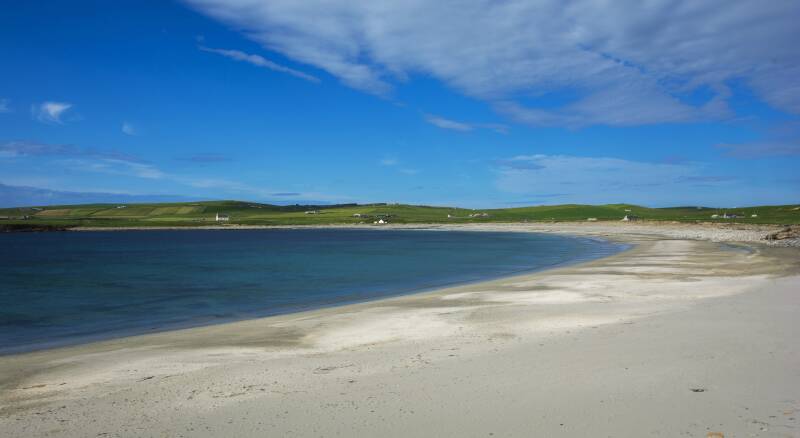
Photo below: the Bay of Skaill on the Orkney Mainland, the Neolithic site known as Skara Brae is located close to the bay, this is where one (possibly in fact two) of the examples of Orkney's mysterious, possible prehistoric writing were discovered. According to the Nynorn website, on the "dialects" page under Orkney Norn, this word "skaill", cognate to Old Norse skáli, seems to possess multiple forms of palatalisation across Orkney Norn dialects, or across Orkney dialects, from what I understand of the examples given.
On the Norn languages
"Norn" is generally used to refer to the Norse languages once spoken on the Orkney and Shetland Isles, but I prefer to use the term also in reference to the Norse spoken generally in the Northern Isles, Caithness, and Outer Hebrides, with it being possible that one could also apply the term to the Norse spoken in the Isle of Man and in West Cumbria, although I do not think that these areas are quite under the same linguistic area is Norn, neither are I think the Norse inscriptions and evidence from elsewhere in Scotland.
When Norn originated in Scotland is unclear, but personally I am of the view that it may well have come into existence before the Viking period, with perhaps elements of it connecting to prehistoric languages on these islands, and to earlier maritime links. This is something I have discussed in a lot of detail elsewhere. The Norn languages are now extinct as spoken languages in their original form, but there are forms of Nynorn or "New Norn", revived forms of Norn, primarily revolving around the creation of a standard Shetland variant of the Norse languages which fits well the traditional nature of Norn, at least to a large degree, but there are many features about Norn which are, in my opinion, too mysterious, and which do not make sense through understood sound change laws, meaning that the Norn language as recorded often contains unintelligible words or phrases, which I think could connect to prehistoric peoples and cultures, and may be confusing possibly because they pre-date the Vikings or Norse in general. Furthermore Nynorn does not incorporate all sound changes or dialect features, but this is again not the purpose of Nynorn and Nynorn is still a great language for those interested in Norn in general.
The Norn language is generally understood to have greatly influenced the "Scots" dialects of Orkney and Shetland, but I think it also possible that what took place was not a simple replacement, but could instead have been a more long term continuity of both Anglic (Scots-like), and Norse, spoken alongside each other on these islands, with remnants of other language influences also present. In the end, only the Anglic (Scots-like) Orkney and Shaetlan dialect groups survived, although they may for a fair while have already served as cross-cultural communication systems, between Scots-like, Norse and other language speakers. This is why I think the Shetland and Orkney Anglic languages or dialect groups contain many words that do not appear to be of Norse nor Anglic origin, and why in known examples of Shetland Norn, we often see evidence of a perhaps wider system of Scots-like words, that in a sense help the Norn to "flow" and to fit together, for example the use of and - "and" in some examples of Shetland Norn, as quoted by Edmonston and Jakobsen.
Whilst Nynorn does not incorporate all dialects, forms of Shetland Mainland Nynorn, Foula and Westside Nynorn, Orkney Nynorn and Caithness Nynorn have been developed to different extents. The following sentence demonstrates some of the differences between these reconstructed dialects, the sentence "he is on a boat", which in Westside/Foula Nynorn would be: ann jar wå båti, in Shetland Mainland Nynorn: hænnj er å båti, and in Orkney Nynorn: hann ir å båt, and in Caithness Nynorn: hann er å båt.
In terms of more localised dialect features of the original Norn language, it is noteworthy that whilst Old Icelandic ð and þ are not generally pronounced in Shetland, with ð usually being dropped or becoming d, and with þ generally becoming t or d, this change is not consistent, and sometimes dental fricative sounds also evolved in Shetland Norn from what is a t in Icelandic. These sounds are also found in Orkney and Caithness, and generally to a greater degree. Norn on the Shetland mainland often possesses palatalised consonants, and voiced intervocalic stops, the former connecting Shetland Norn to many Norwegian dialects, the latter being something specific to certain Norwegian dialects, and being connected to similar processes of voicing in Danish, although not involving the exact same sounds, often. Palatalisation, but of fewer consonants, was also present in Orkney Norn dialects, although this occurred differently in different parts of Orkney.
A mostly intelligible example of Shetland Norn from the island of Unst is the following recorded conversation:
.Mårjan, ara du iņe?
.Jō!
.Sala slāg däin før ķø˙rən?
.jo ģεra so, ģεra so!
Which can be broken down as: Mårjan - Marian, the personal name, ara du iņe? - "are you in", from ara - "is", "are", du - you (singular), iņe - "inside", jō - "yes" (agreement"), sala? - "shall I?" slāg - perhaps meaning to "flit", däin - "your" (singular), før - "for", ķø˙rən - "(the?) cows", jo - "yes" (in agreement), ģεra - "do", so - "so", ģεra so - "do so". Another very intelligible phrase from Shetland Norn, this time from the generally (in my opinion) more intelligible mainland form, is the proverb: gỏit a taka gamla manna rō - "good to take the advice of an old man", from gỏit - "good", a - "to", a taka - "to take", gamla manna - "old man", with presumably the -a on manna added for prosodic purposes as an inserted vowel, rō - "advice".
The following is an example of Shetland Norn titled Valafjell, only parts of it are intelligible. There are three examples of this verse, all of which seem to be from the island of Fetlar. According to Ljun's translation on the Nynorn Kjokl forum, this is a song about fishing around Unst, Yell and Fetlar, and I agree largely with this, as Vâlafjel seems to be in reference to the mountain of Valla Field on the island of Unst. I am not sure whether or not this name, Valla Field, or as given in the verse below: Vâlafjel, is equivalent to Old Norse vǫllr - "field" and Old Norse fell - "mountain", or if the latter word is more connected to Scots field - "field".
Vâlafjel wəz tỏ'rt o brota
hâfatu wizo hâla
fram såkəto dafa vogədə nỏit
æn rūdə kriŋədə âla
I will translate the parts of the above which I am more certain of, my translation differs from that of Ljun's. The above may be broken down as: Vâlafjel - "field-field" or "field-fell" (or some other reinterpreted meaning from a different origin?), wəz - "was", tỏ'rt - unknown meaning, o - possibly meaning "and", Old Norse: ok, Icelandic: og; brota - possibly meaning "steep", connected to Old Norse brattr or brantr - "steep", hâfatu - possibly the hâf- element refers to the sea or more specifically to the Ocean, compare Barra Gaelic: Na Haf - "Atlantic Ocean", Old Icelandic haf - "sea", although this may also not be the case at all; wizo - the wiz- part likely means "was", the -o may have been a part of the next word, or may be equivalent to Icelandic á - "at, by", hâla - meaning unknown, fram - "forth" or "forward", såkəto - meaning unknown, dafa - possibly meaning "days", Old Norse: dagar, vogədə - possibly the past tense of a verb equivalent to Norwegian våke - "to watch", "to stay up", or "to wait", related to Old Norse vaka of the same meaning; nỏit - "night", Norwegian: natt, Icelandic nátt or nótt; æn - likely meaning "and", equivalent to Shaetlan and; rūdə - likely equivalent to Faroese róði and róðu (plural), meaning "rowed"; kriŋədə - perhaps a combination of what is in Old Norse kringr - "around", compare Norwegian kring - "around", plus the definite article -də - "the"; âla - this word may refer to the Isle of Yell, but this is uncertain; if this is so, then -də âla may mean "The Yell" (island). Note that, from what I understand, the a with a circumflex accent in this text, written â, represents a somewhat diphthongised sound found specifically in the North Isles, Yell, Unst and Fetlar dialects of Norn, this sound being a kind of diphthong and similar to the Faroese á, [ɔɑː].
Then we get onto the phrases of more magical sayings and formulae, things associated with the Fin-men and more so with trolls, sayings which I have discussed elsewhere and which can, to a great degree, be unintelligible, and I get the impression that even when parts are intelligible, that these may be later additions or interpretations. An example I have not discussed before is another unintelligible troll saying: di rua vatta mega sustri - although certainly some of these words bare similarities to Norse words, the only ones I notice is that rua may connect to rowing, and that mega could relate to Old Norse mikit - "great", "big", "a lot"; whilst vatta could refer to "wights" or to "water". It is impossible to say, and these are just some interpretations of my own, and others have noticed these similarities in their own way. Another example I have not discussed before is another example said to have been said by a troll (trow) to a man, and is: katta mŏga de līde lō. In this example, de is likely the definite article or means "they", and there are again some similarities to Norse words, but none of the comparisons are so certain as to be able to translate the meaning accurately. It is also possible I think that lō may relate to Icelandic lá - "lay".
An example of what appears to be a magical phrase, with large parts unintelligible, rendered in more Shaetlan orthography and language, is the following. I have discussed its possible meanings in a number of other publications, and its possible connection to Finnish (as I have discussed other, further examples of unintelligible sayings and rhymes from Shetland in other publications, and not included in this article), but in essence it was a charm of sorts for laying the wind at sea:
Robin cam ow’r da vaana wi’ da sköna
Twaabie, toobie, keelikim, koolikim
Pattrik alanks da Robin
Gude runk da gro
Apart from the example given directly above, and the examples of the Lord's Prayer discussed below, all the other Norn (not Nynorn) text examples discussed in this article were those discussed by Edmontson and Jakobsen, and which are also given on the Nynorn website (not my website), the address to which is: https://nornlanguage.x10.mx/ . My discussions on them and interpretations are different from those given on the aforementioned website however. The examples of Orkney Norn discussed below and not from the Orkney Norn Lord's Prayer, are also available on the aforementioned Norn website, and are forms given originally in Hugh Marwick's book: The Orkney Norn. Whilst again my discussions and writings are different, the examples of Foula Norn from the Hildina Ballad as given further in this section, are also available and visible on the aforementioned Norn website.
The best example of Orkney Norn is the Orkney Norn Lord's Prayer. Due to the orthography it is sometimes difficult to work out precisely which sounds are being represented, for example the Orkney Norn form chimrie - "heaven", might be pronounced with an initial [x], [ç] or [tʃ], it is unclear. But nevertheless some sound difference from most Norse forms of this word, which begin with [h], is implied. Either a form of mutation to a dental fricative, or a t followed by a h sound is implied in the spelling of Orkney Norn muthi - "against", compare Icelandic: í móti. Two words joining together is also implied in the text from the words meteth vera - "may it be", compare Icelandic: mætti það vera. The first line of the Orkney Norn Lord's Prayer, are: Favor i ir i chimrie. Broken down, these words mean: fy-vor - "father-our", fy- - "father", vor - "our", i - "who", ir - "is", i chimrie - "in Heaven. The Orkney Norn Lord's Prayer was recorded by James Wallace and included in: An Account of the Islands of Orkney. London: Jacob Tonson, 1700. The first line of the Shetland Norn Lord's Prayer, as recorded on Foula, is: Fy vor or er i Chimeri; which is very similar to the Orkney version, and can be broken down as: fy - "father", vor - "our", o(r) - "who?" (I am unsure on this word), er - "is", i chimeri - "in heaven". This demonstrates also some of the similarities between Orkney Norn and Foula Norn, which I will go on to discuss other aspects of.
The Foula version of the Lord's Prayer was recorded was George Low, and was published in the book: A Tour through the Islands of Orkney and Schetland. Kirkwall: William Peace, 1879.
As in Faroese, there is sometimes a tendency in Orkney Norn for Icelandic or Old West Norse initial þ to become a h-, although this seems primarily to exist in place-names, and I wonder if this process in Orkney Norn, and in Faroese, might come from a non-Norse culture who pronounced these names with non-Norse linguistic patterns. Examples of this change can likely be seen in the Orkney place-names Hurteso and Horraldshay. A similar change seems to exist in the Norn language of the Hildina Ballad from Foula, off Shetland, where eso appears to be the equivalent of Icelandic þessi, with Icelandic þann being equivalent to Foula Norn an, and with Icelandic þetta - "that", being represented by Foula Norn ita. The sound change in Foula Norn is similar, keeping in mind that Foula Norn also had the tendency to drop initial h- sounds.
Some examples of Orkney Norn sentence structure are also preserved in certain fossilised phrases found on Orkney, for example taragott - "it is good", compare Icelandic: það er gott. The Orkney Norn phrase clearly shows a repositioning of r from Vr- "is, are" in relation to the surrounding vowels, with an extra vowel being inserted after the -r-.
Orkney Norn also possessed some interesting sound changes, for example Icelandic gýgjar - "giantesses", seems to represented as gyre- and geyar- in Orkney Norn, with geyro seemingly being the Orkney Norn singular form, equivalent to Icelandic: gýgur.
Like Orkney Norn possible, the Norn of Foula as attested in the Hildina Ballad seems to show evidence of what appears to [x], [ç] and possibly (in the case of the Hildina Ballad) - [ɣ] sounds, although in the case of ch spellings it is still remotely possible that in some cases the pronunciation was [tʃ], although this is I think unlikely. The former, other sounds also occur in Icelandic in sometimes similar positions. Examples include Foula Norn yach, yagh and a, all equivalent to Icelandic ég - "I"; Foula Norn moch - "me", Icelandic: mig, and for example tuchta - "seemed", Icelandic: þótti. We also find in the Hildina Ballad what appears to be a dental fricative, or at least a sound written as th, replacing what would be a t in Icelandic and in Faroese. Examples include: grothè, equivalent to Icelandic gráti - the genitive of grátur - "weeping" (the noun); and i muthi - "against", Icelandic: í móti. In a sense these examples seem to indicate certain similarities between Foula Norn and Orkney Norn, with in a sense the other dialects in Shetland showing a language, in some ways more typically Norse, but generally sharing more similarities with Shaetlan (the Scots-like language of the Shetland Isles). Was perhaps the Norn language always stronger in Foula than elsewhere, with the Norn language on Shetland as a whole having been more limited, even ceremonial?
Evidence of Norse (and pre-Norse?) language survives in the place-names of the Outer Hebrides, with the Gaelic language containing a large number of crossovers in vocabulary with Nordic (and I think pre-Nordic) languages, although it is not certain in my opinion how many of these words are "Norse" and how many of them originate from earlier languages and could have passed into Gaelic and Norse.
A thing rarely discussed is what the Norn language may have been like on isolated islands, connected to the Orkney and Shetland archipelagos, and to what degree Norn might have been spoken there; for example, on the island of Stroma in the Pentland Firth, between Orkney and Caithness; and on Fair Isle, which lies to the south of Shetland, but is still a long way from Orkney. With Stroma being located in the dangerous, often fast-moving and rough waters of the Pentland Firth, which connects the North Sea and Atlantic Ocean through a sound or channel, I think it entirely possible that the Norn spoken there would have been somewhat isolated, and perhaps distinct from that of Orkney in certain ways. It would depend I think upon the level of contact, and with which areas specifically, between the people of Stroma, and the people of different parts of Orkney and Caithness, in historic times. It is also possible of course that Norn was never greatly spoken on Stroma, and was instead mainly employed by the locals of the island in specific naming systems, with regard to the island's place-names, and with the island itself being equivalent to Orkney Nynorn: Stroumej - "Tidal-Stream/Stream-Island". What, then, if that was the case, was the local Anglic, Scots-like dialect of Stroma like? The name Stroma itself, may, to some degree perhaps, suggest that at least by those who named the island, the Orkney Nynorn ou in this instance might be better represented as o.
Fair Isle has been occupied since prehistoric times, and it is quite isolated, making it possible that continuity could have developed in some way on the island, linguistically, in the past. The attested dialect of Fair Isle is certainly closer to the Shaetlan language on the Shetland Isles than it is to the Scots dialects of Orkney Language on the Orkney Isles. The following words were recorded in the book: A to P, An old record of FAIR ISLE words with phonetics, by Bettt M Best, published in 1987. These words were then also published on the webpage titled: FAIR ISLE DIALECT & THE SEA, published on the Fair Isle Marine Environment & Tourist Initiative website. I will only discuss a few of the words here. One of them owse - "to bail water out of a boat", this word is clearly related to Old Norse ausa of the same meaning, and sometimes with wider meanings attached. Another interesting word I would like to discuss given on the aforementioned website, is köthes, which refers to young saith fish. The presence of the -th- is interesting here, and may I think coincide with how dental fricatives sounds seem to have been preserved to some degree in the Norn of southern Shetland. The word aända, which refers to keeping the boat in one position against the wind and tide, whilst fishing, is interesting for its use of the letter ä in the spelling of this dialect by the original writer of the book.
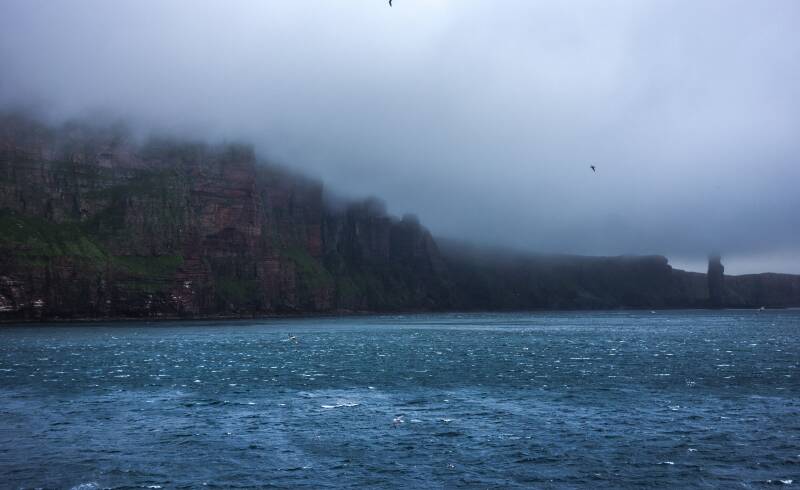
Photo below: the west coast of Hoy, one of the Orkney Islands, rendered sometimes as Håej in Orkney Nynorn, this is the only Orkney islands to possess true mountains, and the famous Man of Hoy can be seen towards the right of the image. . This island is indeed one of great mystery and intrigue.
On the Faroese language
The Faroese language is spoken primarily in the Faroe Islands, which lie further north than Shetland, and roughly between the Shetland Islands and Iceland. Faroese shares a number of radial similarities with Norn, but in many respects, Norn shares more phonologically with certain Norwegian dialects, and with Gøtudanskt, than Faroese does. Faroese also has a number of vowel changes, which seriously give Faroese a much different sound to Norn. The modern Faroese spelling is a very "etymological" spelling, rather akin to how Scottish Gaelic standard spelling is very etymological. Such spelling systems do help to bridge the gap between modern spoken dialects and an idealised or actual ancient past, and its literature and prose. But etymological spellings (as can be seen with Scottish Gaelic), often do not allow for the spoken colloquial dialects to be fully represented, nor readable as distinct entities beyond the etymological, idealised ancestor language. This is why for example the Icelandic word hjá - "by, near" is pronounced [çau], whilst the Faroese equivalent, also spelled hjá, is pronounced [t͡ʃʰɔɑː]. Personally, I do wonder if in the future, people in the Faroe Islands will start to use more phonetic spellings again, at least in certain contexts, to more accurately represent the language's spoken dialects. Jakob Jakobsen, among other writers, used more phonemic ways of spelling the Faroese language.
For example, standard Faroese spelling maður, would be spelled in Jakobsen's spelling as mävur, with ä being used to spell the [ɛaː] diphthong, another example is tä , compare standard Faroese spelling: tað, and häva - "to have”, standard spelling hava. There are other differences in spelling, for example the use of the letter å, e.g. in båtsmävur, standard Faroese spelling: bátsmaður - “boatman”.
The written vowel æ is also used in Jakobsen's Spelling, for example in the word sjægvurin - “the sea”, standard Faroese spelling: sjógvurvin. The soft k sound, [tʃʰ] or [tʃ] is written kj, e.g. Mikjenes for Mykines.
Some writers used grave accents to mark long vowels, e.g. in Hammershaimb’s earlier orthography, note that acute accents in standard Faroese today generally represent diphthongs and not long vowels. Examples from Hammershaimb’s spelling include for example rùvar for roðar - "reddens" (as in the sunrise).
I think that perhaps dialectal spellings of all the languages discussed in this article are very necessary and important for representing historic speech and language, even if in the case of Norn and some Gaelic dialects, and other languages, the evidence is limited, it is important to represent things as they were pronounced and known on a local level, alongside the use of standard language varieties.
This article is dedicated to all speakers of the languages discussed in this article, past, present and future, and to the ancestors of these islands and to all living things upon and connected to them, and to the islands themselves. I hope this article has been an interesting read, blessings to all.