

On three languages of Troms: Tromsødialekt, N. Sámi & Kven, publ. 30/07/2026
Written and published by Linden Alexander Pentecost, published on the 30th of July 2026, published in the UK, I, the author also wrote the example sentences in the three languages, and took the three photos include. Neither this article nor any of its or elements have been published before. This article was published in the UK, and no AI was used. This article contains 2811 words.
When many think of Norway, the Norwegian language perhaps comes to mind, but in reality Norway is linguistically diverse. Not only do the Norse dialects within Norway (generally called “Norwegian dialects”) differ greatly between different parts of the country, Norway also has a number of other languages belonging to the Uralic language family.
These Uralic languages include several Sámi languages, with historically: Southern Sámi, Ume Sámi, Pite Sámi, Lule Sámi, Northern Sámi and Skolt Sámi having been spoken in Norway to some degree or other, with the Northern and Southern Sámi languages covering the largest areas historically. In addition, the Kven language, sometimes thought of as being a form of Northern Finnish, is still spoken in parts of Northern Norway, with Kven peoples and Finnish people having once lived more widely in Norway.
Other languages were likely spoken in Norway in the past, languages spoken a long time ago, which may have been connected to Sámi languages, Finnic languages and Norwegian dialects in some ways and to their speakers, but which connect to “in-between” archaeological cultures, cultures which cannot be readily identified with any of the aforementioned language families in terms of historic continuity.
I want to discuss in this article three of the languages from Northern Norway, namely: Tromsø Norwegian, Northern Sámi and Kven.
Troms Norwegian describes the varieties of Norwegian spoken in the historic county of Troms, the most northerly county in Norway, bar Finnmark, a way to the east. The capital of this county is Tromsø, which is connected by the E8 and E6 Highways going generally southwards and through inland Troms, towards Bardufoss, Setermoen and Narvik in the county of Nordland to the south.
The western coast of Troms includes the large islands of Kvaløya and Senja, which lead towards the Vesterålen Isles of Nordland to the South, and the Lofoten Isles. Off the north coast of Troms are many more isolated islands, such as Nordkvaløya and Vannøya. The northern coast of Troms has many large fjords, and the Western Kven language was historically spoken along this coastline, and into its continuation in Finnmark to the east.
Norse speaking peoples only historically occupied certain areas of this landscape, and this is why forms of Troms Norwegian in more coastal areas for example, preserve tradition features to the Troms coastal dialects, whereas eastern, more inland parts of Troms, were almost entirely Northern Sámi-speaking, with some Kven, Finnish speakers too in all likelihood, until relatively recently, and so the Norwegian spoken in Inner Troms has various East Norwegian features, because this area was partially settled by Norwegians from that area, which is reflected in the phonology for example, and for example the use of je as the first person singular pronoun, “I”, and the negative particle is itte, in Bokmål Norwegian: jeg, ikke, in Nynorsk Norwegian: eg, ikkje.
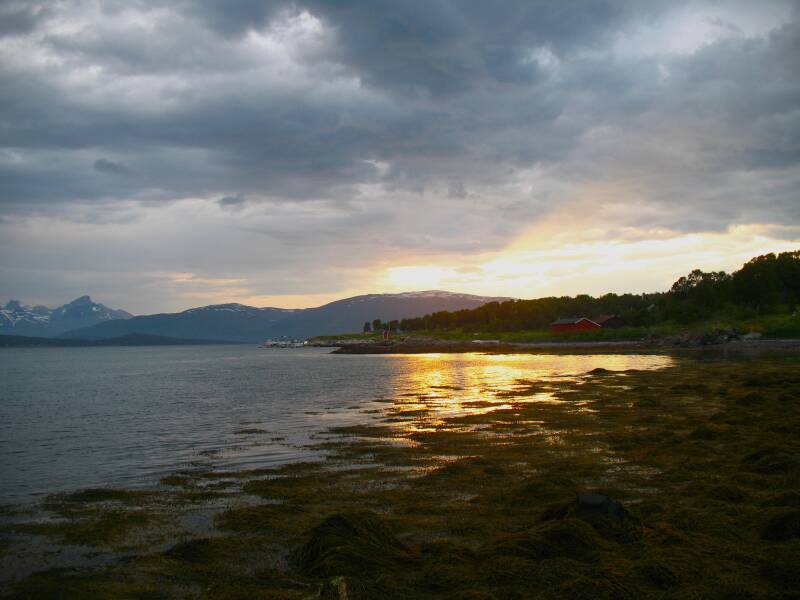
Photo below: the midnight sun circling the sky and casting golden light onto the waters and seaweeds, as seen from the edge of the fjord, with snowcapped mountains in the distance to the left, taken from the island of Tromsø during a heatwave, in July 2011. This is the landscape of the Tromsø dialects of Norwegian.
The Norwegian spoken in Western Troms is by comparison more typically Northern Norwegian, but with its own, sometimes very localised unique features. In comparison the words for “I” and “not” in Tromsø for example are: æ, ikkje. These words are also found in the more-urban Norwegian dialect of Tromsø itself, which, despite being an urban dialect in a sense, and with some users of the dialect using more urban, southeastern Norwegian features, the Tromsø dialect itself is by and large quite tradition, and contains many more traditional Northern Norwegian sound features than say the urban dialect of Narvik does, I have discussed the Narvik dialect in detail elsewhere in many places.
Another typical feature of Tromsø Norwegian and of Northern Norwegian in general is palatalisation, to different degrees, which is often written as an extra i- before the palatalised consonant, for example Tromsø dialect mainn - “man”, lainn - “land”, and foill - “full”, which in Bokmål are: mann, land, full. The interrogative pronouns are also different, they are ka? - “what?”, kem? or kæm? - “who?”, kor? - “where?”, koffør? - “why?” and kosn? - “how?”, which in Bokmål Norwegian are: hva? , hvem? , hvor? , hvorfor? , hvordan?
There are various other differences in this dialect, for example the pronunciation of the r in -rk and -rp as though “rsh”, written as -rsj, for example parsjken - “the park”, Bokmål Norwegian: parken. Below are some example sentences I wrote in the Tromsø dialect, with Bokmål and English equivalents:
Tromsø dialect 1: æ kjeinne ikkje en mainn såm kjæm fra Kvaløya - “I do not know a man who comes from Kvaløya”, in Bokmål Norwegian: jeg kjenner ikke en mann som kommer fra Kvaløya.
Tromsø dialekt 2: d e ikkje mykje vatn i ælva - “there is not much water in the river”, in Bokmål Norwegian: det er ikke mye vann i elva.
Deep elements of Nordic spirituality and belief can also be found evidenced within the landscapes, traditions, Norse dialects and Norse place-names of Troms, although it is important to note that these beliefs are not identical to, for example, the “Viking” spirituality as attested and recorded in Iceland, and it is better to refer to these dialects and historic cultures as “Norse”, “Viking” being a specific lifestyle and cultural sphere that connects to but does not encompass the Nordic cultures and dialects of Troms.
Speakers of the Northern Sámi language, Sámegiella or Davvisámegiella have historically inhabited, or migrated through, named and lived in the landscapes across all of Troms. The Sámi peoples’ spirituality has some similarities to some of the facets of Norse belief systems. For example the Sámi god Horagalles has a name that bares a similarity to the Norwegian deity name Tor, or “Thor” in English, and the Norse art of seiðr bares similarities to Sámi noaidi (shamanic) arts; whilst the Norwegian word troll is sometimes used to describe somewhat similar beings in Sámi belief (I have discussed these beings in detail elsewhere), although troll is used in different senses too; and even these similarities do not suggest that the Norse in any way, shape or form “gave” for example the god Thor to the Sámis.
Rather the Sámi are a very ancient culture, with their own unique cosmology, worldview, sacred language and knowledge systems which are entirely unrelated to, and independent from those of Norse cultures. Because Norwegian is technically more related to say, Greek or Urdu, than it is to Northern Sámi, it can be understood how the Northern Sámi language does not relate to or function like the Norwegian language at all, in nearly all ways.
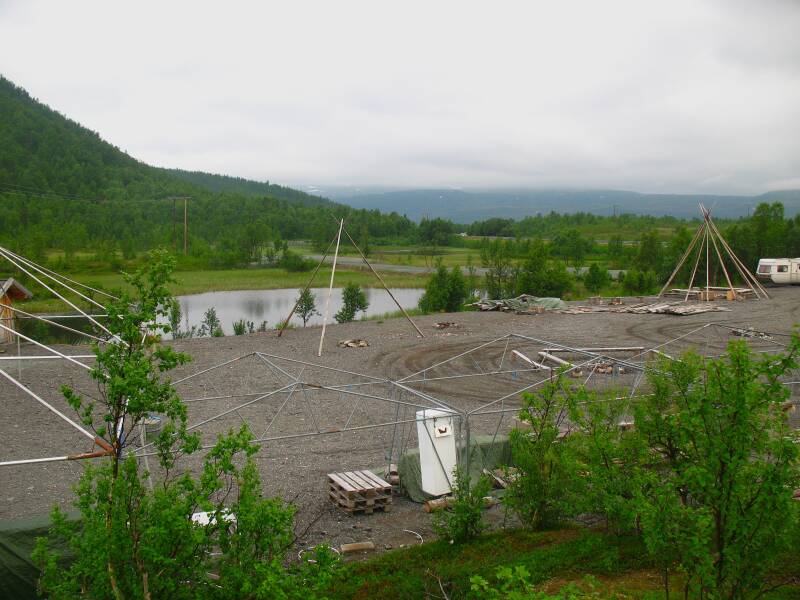
Photo below: Sámi lavvus or in Northern Sámi: lávut, under construction, whilst other parts of the site were readied for the Heiafestival music festival, photo taken at around midnight on a misty evening at Heia, looking roughly towards the mountains of East Troms. Heia is situated roughly east of Moen in Troms, and vaguely south and slightly west of Storsteinnes in the north. This is the place where I first spoke some Northern Sámi. Photo taken in July 2011. The photo below does I think both invoke and show the traditional structures used by Northern Sámi speakers and behind it, the kind of landscape of marsh, lake, forest, and in the distance, snowy mountains, that is deeply bound with the Northern Sámi language.
Northern Sámi does not have as many noun suffixes as Finnish does, and both Finnic and Sámic languages share some similarities to Indo-European languages, Northern Sámi, like Finnish, containing a number of similarities in syntax and wording to what would be found commonly in Indo-European languages, but unlike Norwegian, Northern Sámi is definitely not an easy language to learn for an English speaker, for example, albeit not I think as difficult as Finnish is - when one gets to the more unusual forms of expression in Finnish, "beyond" the more Indo-European structures. This also exists in Sámi but I do not find it as difficult. But the language is, nevertheless, difficult, in my opinion.
A thing not found in Finnish is the use of singular, dual and plural pronouns in Northern Sámi. For example, one way of asking "do you speak Sámi?" to one person, would be: humatgo sámegiela? , but when asking to two people, you would say: hupmabeahtiigo sámegiela? , using the first person dual suffix, and you would say: hupmabehtetgo sámegiela? if asking more than two people if they speak Sámi. The second person pronouns are don - "you singular"/"thou", doai - "you" (dual), and dii - "you" (plural). Similarly the first person pronouns are mun - "I", moai - "we two", and mii - "we" (more than two), whilst the third person pronouns are similar, son - "she" or "he", soai - "they" (two), and sii - "they" (plural, more than two).
Again, sometimes in Sámi the sentences are not too different in structure to those in Norwegian or English, but this only occurs in certain circumstances. For example: Ivguvuotna lea stuorát go Ákšovuotna - "The Lyngenfjord is bigger than the Oksfjord", which can be broken down as Ivgu- term used to describe the Lyngen and Skibotn area of Troms, -vuotna - "fjord", lea - "is", first person singular present tense form of leat - "to be", stuorát - comparative form of stuoris - "big", go - essentially meaning "than" in this context, see note below, Ákšovuotna - (the) Oksefjord, another fjord in Troms.
Note that in the Finnish language, the word kuin means "as" or "than", among other meanings, whereas the suffix -ko is the interrogative suffix, whereas in Kven, kuin is ko, similarly in Northern Sámi, the forms are go (as in the sentence in the previous paragraph), and -go as in the interrogative sentences in the paragraph before the previous paragraph. Note that in addition kun means "when" in Finnish, but in Kven this is also ko, and the Northern Sámi equivalent is go.
Below is a table of words, with, going left to right, three columns, in Northern Sámi, Bokmål Norwegian and English, respectively.
| Northern Sámi/Sámegiella/Davvisámegiella | Norwegian (Bokmål Norwegian) | English |
|---|---|---|
| jogaš | bekk | "beck" or "stream" |
| sámmál | mose | "moss" |
| gáiski | bregne | "fern" (plant) |
| soahki | bjørk | "birch" (tree) |
| vuotna | fjord | "fjord" (a deep sea inlet) |
| jiehkki | jøkel | "glacier" |
| čáhci | vann | "water" |
| biebmu | mat | "food" |
| muossi | fred | "peace" |
| fanas | båt | "boat" |
| suolu | øy | "island" |
| várri | fjell, berg | "mountain" |
| ráhkisvuohta | kjærlighet | "love" |
I first met Sámi people when stopping briefly close to the Lyngenfjord, a large fjord, with its shores historically inhabited by speakers of Northern Sámi and Kven. In Tromsø itself I remember seeing posters written in Northern Sámi, but encountered no Sámis, and only would again in Troms in a small place called Heia, close to the E6 Highway. My dad and I camped overnight at Heia, after I had spent much of a rainy, misty day, speaking to the Sámi people there, and practicing some Northern Sámi with one of them.
One of the men talked a little about the Sámi noaidi traditions with me, and about the sacredness of the stuorra niibi, a kind of large knife, with a handle of birchwood, and the blade made of seal, and the traditions regarding it being used to heal illness, for example by holding or passing the blade over a person’s skin (without touching the skin), and through a larger ritual process and perhaps words, its ability to remove illness, according to Sámi traditions.
I remember the atmosphere at Heia being deeply magical and mysterious to me, especially being camping next to Sámi lávut domestic structures, having been among Sámi people there, spoken some of their language with them, and learned something about their mystical traditions. The entire landscape, especially near some misty lakes close to the lávut camp, felt imbued with a spiritual energy, all of nature, including the mist itself seeming to be alive.
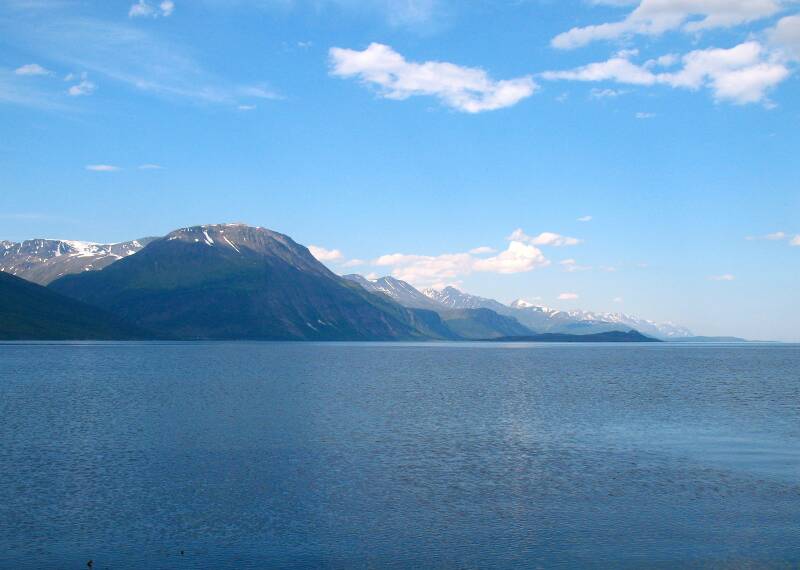
Photo below: the majestic snowtopped mountains on the left extend out as the western edge of the Lyngenfjord, which can be seen in the foreground of the image, taken on a sunny day during a heatwave and with dramatic clouds, taken in July 2011. The photo below does I think powerfully invoke the traditional landscape of the Kven language and of its speakers, one of vast coastal mountains, wide fjords that face to the Barents Sea, and huge blue skies, with lush forests located in the innermost parts of many of these fjords. As I mention elsewhere here, the name of this fjord in Kven is Yykeänvuono , whilst in Northern Sámi it is Ivguvuotna.
The third language I would like to discuss in this article is Kven, a language closely related to Finnish, spoken along fjords and river valleys in parts of Northern Troms, and historically having been spoken more widely, at least to some degree. The Kven people are their own indigenous group and may not identify themselves and their language with the name Suomi used in Finland to describe Finland and Finnish. Below are some sentences in Kven with their English equivalents, and afterwards are detailed explanations of the Kven meanings.
1. Mie olen ollu Yykeänvuonon rannikolla, josta kattoin vuonole
“I have been on the shore of the Lyngen Fjord, (from)-where I watched the fjord”
2. Ko met olema rannikolla, met löyđämä usein raakkui
“When we are on the shore, we often find shells”
3. Met olema olheet tänä kesänä usein venheelä
“We have often been on the boat this summer”
4. Met herräämä aamula kello kahđelta
"We wake in the morning at two o clock"
To break the first sentence down into individual words and phrases: mie - “I”, mie olen - “I am”, mie olen ollu - “I have been”, Yykeänvuonon - genitive singular of Yykeänvuono - Lyngenfjorden, rannikolla - adessive form of rannikko - “coast” or “shore”, josta - elative form of joka - “that”, “which”, kattoin - “I saw”, first person singular past tense form of kattoot - “to see” or “to watch”, vuonole - allative form of vuono - “fjord”, compare Northern Sámi vuotna - “a fjord”.
And the second sentence: ko - “when”, met - “we”, met olema - “we are”, rannikolla - adessive form of rannikko - “coast” or “shore”, met - “we”, löyđämä - “we find”, first person plural present tense form of löyttäät - “to find”, note the consonant gradation from -tt- in the infinitive form to the -đ- in the third person plural present tense form, usein - “often”, raakkui - partitive plural form of raakku - “a shell”. Note that the letter đ in Kven is pronounced like the English “th” in “this”. This sound is not found commonly in Finnish and never in standard Finnish, but is found in the Northern Sámi language, where it is also written đ.
And the third sentence: met olema - “we are”, met olema olheet - “we have been”, tänä kesänä - “this summer”, using the essive forms of tämä - “this” and kesä - “summer”, usein - “often”, venheelä - “on (the) boat”, using the adhesive form of venet - “boat”.
And the fourth sentence, met herräämä - "we wake", herräämä - "we wake", first person plural present tense form of herätä - "to wake (up)", aamula - adessive form of aamu - "morning", kello - "clock" or "bell", in this case meaning "time", kahđelta - ablative form of kaks - "two".
Speakers of Finnish will notice many differences in these words between the Finnish forms and the Kven forms of these words, phrases and sentences. Note the root Yykeä as in Yykeänvuono - "The Lyngen Fjord" and Yykeänperä - "Skibotn" (close to Lyngenfjorden). This root Yykeä is cognate to the Northern Sámi root Ivgu, which is also used to describe the Lyngen and Skibotn regions in Northern Sámi, but note that the root behind the Kven and Northern Sámi roots is of unknown origin, and could well originate in a now-extinct, ancient indigenous language to this region. I have discussed more on this elsewhere and several examples of Northern Sámi and Kven words which could originate in such languages, and possible cognates.
I hope that this article was interesting to read. It is dedicated to the Northern Norwegian, Northern Sámis and to the Kvens