

Written & published by Linden Alexander Pentecost on the 18/07/2026. This blog post is unrelated to and separate from any and all of my other publications; this post was published in the UK on this UK website and I the author am from the UK and live in the UK; no AI was used in this nor in any of my written works; the two photos were also taken by me; this blog post contains 1686 words.
Bowness is a place that I have tended to avoid in the past. I think this is because I find it busy, but also because I just hadn't really given myself the opportunity to enjoy it or to find its positive attributes.
Quite a lot of Japanese people I think visit Bowness, and it occurred to me some months ago that if I wanted to properly speak Japanese this year and to travel to Japan, then Bowness would be a potential place to practice the language, in an environment that, whilst busy, is connected to nature, to forests and to the lake, with views to the mountains, a landscape which in some ways mimics those of Japan.
I didn't actually meet any Japanese people when at Bowness most recently, instead, I just wandered the shores with my dad, and pointed out Japanese names for various things. Like mizu, みず - "water", mori, もり - "forest", sora, そら - "sky", fune, ふね - boat.
My knowledge of Japanese grammar hasn't really progressed beyond my ability to use a few particles in basic sentences. In a way the particles remind me sometimes of the nuanced usages of Finnish suffixes, and there are even more profound similarities between the Finnish and Japanese languages, which I have discussed elsewhere.
Photo below: Lake Windermere from near Bowness, "lake" is mizuumi / みずうみ in Japanese, and järvi in Finnish (with the j pronounced like the English "y" in "yes"), and is agám/אגם in Hebrew.
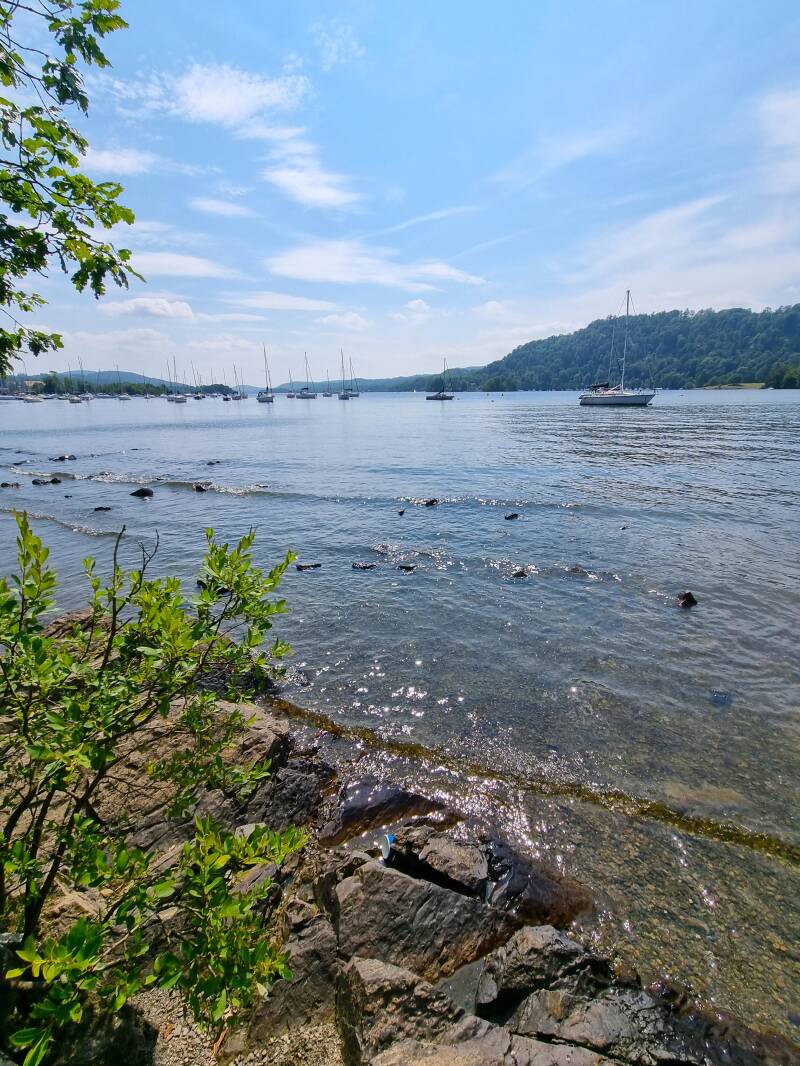
Take for example if I was to stare out onto Windermere from Bowness. And if my dad said “it moves on the water!” My natural reaction would probably be to ask “what, a boat?” Or simple “a boat?”
If I was to ask this in Finnish I would simply take the word for boat - vene, and attach the interrogative suffix -ko/-kö, in this case -kö, so venekö? means “a boat?” in terms of asking whether or not something is a boat.
In Japanese I would take the remarkably similar looking word for “boat”, which is fune, and then add after it the interrogative particle ka, which is again remarkably similar to the Finnish interrogative suffix, thus I would say in Japanese fune ka?/ 船か “A boat?” Note that this question uses Kanji writing, rather than the Hiragana spelling I give earlier for fune which is: ふね.
Japanese and Finnish are not “related” in terms of them being officially or technically understood as being in the same language family or historically connected. Japanese and Finnish are by and large very different languages.
However, there are similarities which I have discussed in detail elsewhere. And I will just say that the fact the words for “boat” are similar is perhaps significant. There is a lot more to this which I have already discussed different aspects of in many places elsewhere.
Another similarity for example is that metsä is forest in Finnish, whilst matsu, まつ in Japanese means a “pine tree”. Note that in Kanji writing, matsu is written as 松.
Speaking of Finnish forests (which I will get onto again shortly), another thing that came to mind whilst wandering around the shores of Bowness is the way in which you can use the suffix -la/-lä in Finnish to imply a realm or place, rather like the Welsh word lle - “a place”.
This began because I had been learning the Finnish song by Kotiteollisuus called Tuonelan Koivut - meaning “The Birches of Tuonela”. I then sung this song by the shores of Windermere and probably confused a few people in the process. Note that I also discuss Kotiteollisuus in an unrelated blog post on another website recently.
The word Tuonela is the Finnish name for the Underworld, derived from Tuoni, a poetic Finnish word that personifies the word “dead” in an animistic sense, the normal Finnish word for “death” being kuolema. Tuonela is derived from Tuoni plus the suffix -la and so Tuonela literally means “the place of death” or “the realm of the dead”. Also in the lyrics of Tuonelan Koivut by Kotiteollisuus, we find the word Onnelan, which is the genitive singular form of Onnela, another noun derived using the -la suffix meaning “place”. Onnela translates to something like “paradise” or “heaven”, but it is literally derived from the word onni, which means “happiness”, “luck” or “joy”, and thus Onnela can be translated to mean “Place of Happiness” or “Place of luckiness” for example.
The concept of “luck” is very important in Finnish tradition. And I don't think that our idea of “luck” in English is really the same thing. In English and in western spiritual culture in general, the word “luck” often for me carries negative connotations, because it is used in a black and white way to talk about “good luck” and “bad luck”.
Whilst walking through the forests of Bowness close to the lake shore, I contemplated how it is probably more positive for me to not see experiences in terms of “bad luck” or “good luck”, and that instead, by not seeing things in terms of good luck and bad luck, I can carry my own luck within me and allow it to reveal itself.
As I mentioned, “forest” in Finnish is metsä. Dialectal variants include mettä, mehtä and meθθä for example.
But another, more poetic way of saying “forest” is to say Tapiola, again using this -la suffix meaning “place”. Tapio is the Finnish god of hunting and of the forests, and thus you can call any forest Tapiola - “the realm of Tapio”. By doing this myself I am acknowledging in an animistic way that every forest is an extension of Tapio's realm. Finns historically used language in this way to acknowledge their inherent spirituality and animism, and their beliefs about, and connections to, these things. By recognising the forest as Tapiola, we make our relationship to these spiritual archetypes and beings, more conscious and deliberate, and this can also be seen as a form of respect and acknowledgement. The name Tapio is connected to the verb tavata - "to meet", I have discussed this root and its etymological connections to distant other languages, elsewhere.
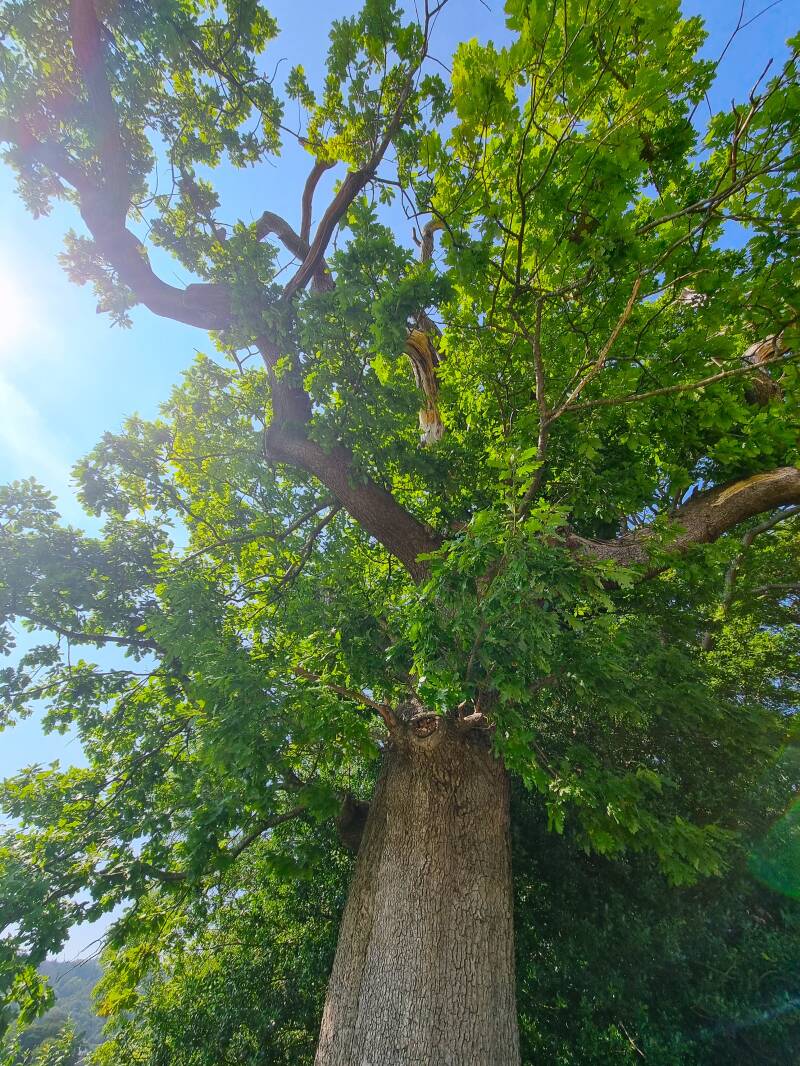
Photo below: an oak tree near the shore, near Bowness (unrelated to the photo of an oak tree and discussion on words for "oak" above the photo in my unrelated blog post on this website previous to this post on this website). To give some other words for "oak" now, an "oak tree" is tammi in Finnish,and is Allon/אלון in Hebrew, also a beautiful word. In Japanese, the word for a "European Oak" tends to be ōku, オーク, which is borrowed from the English word "oak". Note that in my unrelated blog post on this website before this one I discuss some Germanic and Celtic words for "oak" above a different photo showing oaks.
Whilst in Bowness I was also thinking about and visualising the landscape through Hebrew. I don't know much Hebrew, but it is strange that when I do learn bits of Hebrew, I seem to remember and to pick them up with ease.
I also experienced this when I was 16, and I went with my dad's friend (from Israel) up Skiddaw in Cumbria. He is a great guy, and kind, and I feel some kinship towards him.
When I was 18 I learned Hebrew for a month or so when my grandmother was in hospital, just before she died. I never really picked up Hebrew since, probably because of the sad association, but I remember how naturally the language and even its written form seemed to come to me.
I partially put this down to that I have some Jewish ancestry of unknown origin, although I think it's equally something spiritual inherent within the Hebrew language that I recognise. And also it is worth me pointing out that as much as I love Hebrew, Finnish is “my” number 1 spiritual language, for me personally.
A few days ago I met some lovely Jewish people in Cumbria. And I did feel almost like they immediately accepted me, and I immediately liked them, which was lovely. And it also doesn't happen to me so often. They taught me some words, which I somehow immediately remembered perfectly.
There are three words which I learned (or re-learned), which are my most favourite. Note that I do not write them in the Hebrew abjad Firstly, “flower” in Hebrew is pérakh, written in the Hebrew Script as: פרח. The Jews I met pronounced this word with the r as being an uvular r, like the French r, but I personally prefer to use the rolled r, which does occur in this word in some varieties of Hebrew spoken today.
The second word I learned was yaré'akh, meaning “moon”, written in the Hebrew Script as ירח. This word invokes for me the divine sacredness of the moon, and I envision the moonlight shining through the warm air, onto the dry rocky outcrops near somewhere like Jerusalem for example.
The third word of these favourite words is one I already knew from years ago, shémesh, meaning “sun”, written in the Hebrew Script as: שמש. And shémesh is I think a very beautiful word for “sun”, invoking the life giving warmth and feeling of joy as the sun shines on one's skin and across a landscape, beyond the horizon.
I hope this article/blog post inspires and was a fun read. It is written in honour of the people I have met recently.
Add comment
Comments