

Written & published by Linden Alexander Pentecost on the 28th of July 2026, this blog post/article is unrelated to and separate from any and all of my publications. No AI was used in this publication, and this publication was published in the UK. I, the author created the artwork included in this blog post, which has not been published before and is unrelated to my art of an agdy which is published in an unrelated article elsewhere. This blog post contains 785 words.
Russian folk religion and indigenous beliefs here refers to that of the Russian Slavic culture, and not to that of the many hundreds of other indigenous peoples throughout Russia. Of course the folk beliefs within the Russian speaking, Russian language culture will also connect to those of other indigenous groups to a degree. Recently, when I published an unrelated article about flotoyggjar, I implied an intention to write about such an island known in Russian folk religion, known as "Buyan", or in Russian spelling: Буян. I will not go into too much about the island here either, but I will mention a couple of very interesting things to start with here.
A mythical being known to inhabit Буян, according to Russian folklore, this island is inhabited by Gagana, Гагана, a bird with an iron beak. The archetype of this mysterious bird being is similar to that of the Kokkolintu in Finnish tradition, and to the Agdy of Evenki tradition in Siberia, all of these beings are said to be at least in part made of iron, or have parts of their bodies made of iron. The Agdy are associated with the Tungunska Event in Evenki tradition. Similarities can also be seen to the Wakíŋyaŋ - "thunderbirds" of Sioux tradition.
The Wakíŋyaŋ are beings of great authority, like the Agdy. The Gagana, Гагана seems linked to authority on a high level as well, as on the island of Буян, Buyan, the Gagana is said to guard a stone of incredible power and magic, known as the Alatyr, Алатырь, and is helped to guard it by the Garafena, Гарафена, a snake.
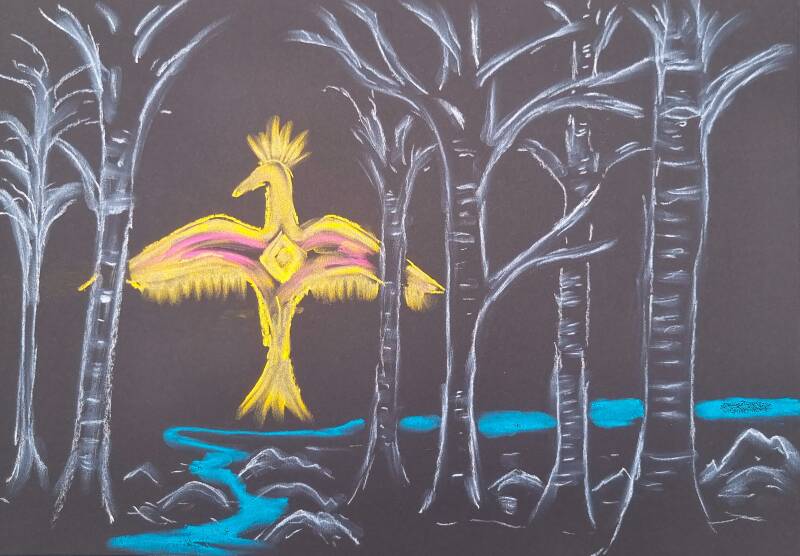
Another holy bird in Russian folklore is the Жар-птица, Zhar-Ptitsa, or Firebird in English. Whilst some of the aforementioned divine bird beings are associated with fire, the Жар-птица is associated with fire in a much more gentle way. This bird seems to burn or glow in a sense, like the embers of a fire, yet bright, reds, oranges, yellows. Each feather of the Жар-птица similarly glows, even if one falls off.
Photo below: some artwork I made with pastels, showing a Жар-птица raising its wings, and gently flying upwards, among a forest of ghostly birches, and with a stream below. The crest on the top of the being's head was, in different ways, historically a common thing added to this bird being in artwork. I feel that all artwork of this sort, like that below, is not so much a creation of the artist, but is also the spirit of the thing being depicted, making itself visible to the artist and thus visible through their hand.
This being is sometimes associated with eating golden apples, and is sometimes seen as a giver of hope, although in folktales it is often seen as the initiator of a hard adventure, which is often both negative and positive for the character who goes on the adventure, the adventure being often initiated by the character finding a feather of the Жар-птица and then looking for it. This aspect of the Жар-птица eating golden apples, and in fact the general description of this being, have a few similarities with the Alicanto, a mysterious, flightless bird being known from the Atacama desert, said to shine or glitter with the colours of the metal ores it had eaten, similarly perhaps to how the Жар-птица eating golden apples may connect to the being's golden glow.
There are also many similarities between the Жар-птица and the Phoenix, although I am not certain to what extent the similarities between these two beings go, beyond their fiery appearance and feathers that is.
Another thing I find fascinating in Russian tradition, are the Volkhvs, singular Volkhv, in Russian: Волхвы. These were wisemen, like wizards in many respects, who held divine knowledge and were of a high authority, and can also be seen as akin in a sense to the Druids of Celtic tradition.
I hope that this blog post was an interesting read, it is dedicated to the ancient Rus, Finns, Evenki & Sioux, and to the Firebird, the Gagana, Kokkolintu, Agdy and Thunderbirds.
Add comment
Comments