

This blog post contains four sections, 2685 words, and one photo. This blog post was written and published by Linden Alexander Pentecost, no AI was used. I, the author, also took the photo. The topics in this article are interconnected profoundly, even if this may not be obvious from the titles of the four sections alone. This article/blog post is unrelated to and separate from any and all of my other publications. This post was published on the 28th of August 2026, pretty early in the morning UK time. This post was published in the UK and I the author am from the UK & live in the UK. Note that this blog post contains some sensitive topics, so discretion is advised.
On spirit and soul, do we misunderstand both?
I think that maybe, languages really have confused our understanding of spirituality - not the fault of languages themselves, but due to the complex interplay of change and illusion that has permeated our reality and history.
Nowadays we may use the terms "spirit" and "soul" in the same way, but they were not originally understood as being the same thing. The word "spirit" is connected to Latin spirare - "to breath", which may incidentally be related to a Germanic word meaning "to fart" or "blow". So the "spirit" is connected to air, to the ether, to wind, just as in the Bible, God is connected to whirlwinds, and to the breath of life. In Finnish mythology the God Ilmari whose name derives from ilma - "air", may have been the original Finnish creator god, and similarly connects the spirit with the concept of a single divine creator or creative entity of life.
The word "soul" has a different meaning. I personally believe we can learn something about this word by looking quite widely. For example, the English word "soil" is similar, as is the Spanish word sol - "sun", and Norwegian sol - "sun". There is also a connection I think to Uralic and several other words for "eye", e.g. Finnish silmä - "eye", and Scottish Gaelic sùil - "eye". There are also similar sounding terms connected to water and to salt. For example English "swell", English "salt", and Scottish Gaelic sàl - "saltwater", and many other examples. There are also similar words referring to frost or dew, for example Quechua sulla - "dew", and Northern Sámi suoldni - "dew", "mist" or "frost".
I think that by looking at connections in words, it is possible, perhaps, to peel back the later layers of our linguistic, spiritual reality, and to see things for what they might originally have meant.
In this case, perhaps the "soul" is something connected to soil, the divine earth, and also to the sun, to holy celestial light. It is perhaps also linked to the eye, the eye connecting in some way to this earth, and light, and water - "soul" also I think connects fundamentally to water, as movement, as flow, just as sunlight has waves, so does water. And that the "soul" is also connected to dew, and to mist, to the celestial waters in the air.
We can think then of the "spirit" as being the thing that gives us our individual time on earth, and our divine god-self, whilst the "soul" is more like the essence of our time its halo, the storm and flow of solar, or water energy, around the blue light shining from the black hole at the centre. This, ironically (or not) also connects to "farts". The anus is like the black hole, and in this case a word for "fart" might be related to the word for "spirit".
The concepts of "spirit" and "soul" are of course linked, but they are different descriptions, describing different facets, reflections or aspects of the divine self. These words that are possibly connected to "soul" are not all describing the "soul". The point is, I believe, that at one time, all of these words were describing the same thing, and now we all have different "parts" of facets of the understanding of what the original thing is. So rather than thinking of the "soul" in terms of something purely defined through our language and concepts, perhaps what we understand as the "soul", what the ancient Finns understood as connected to the "eye", what others associated with the solar energy, with salt, and water, are actually describing a spiritual reality that is all of these things at once.
I realise that in terms of etymology many of these words are not supposed to be related through our current understanding of languages and their historic reality, but nevertheless I think that these words share a connection that is beyond our cultural linguistic reality.
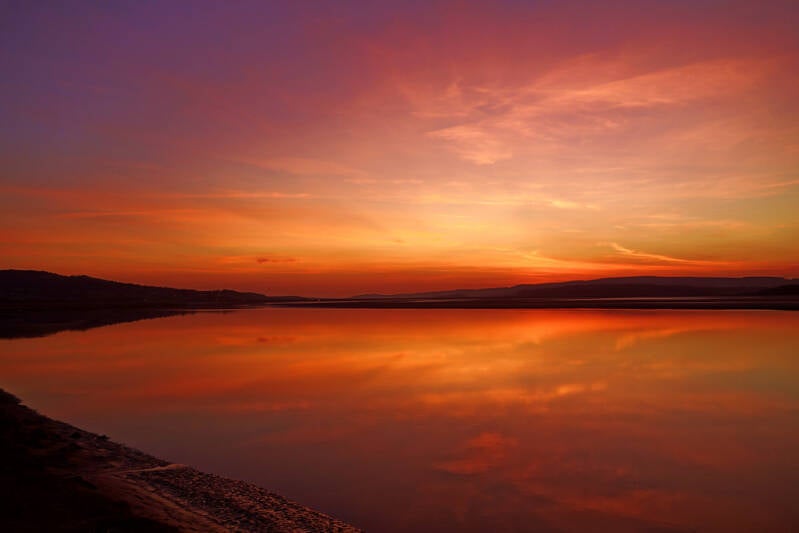
Photo below: a photo I took when in Cumbria in 2013, I think that the photo below, showing a winter sunset reflecting upon the water, is special, also is also a beautiful representation I think of "soul" energy, something full of colour, full of flow, depth, glow, reflection, bright with heavenly life, in the waters of the estuary and in the waters of the sky.
Elven aspects of the Norse linguistic reality
In our modern reality, we may think of languages as systems of direct equivalence, like numbers written in a different ways, but which are of equivalent meaning. But this is not quite true.
There are I think overreaching, sacred patterns in language. But as it describes with the Tower of Babel in the Bible, the languages were confused. Things were split, reflected into shattered pieces, each a facet of their original form, and humans experiencing time and reality from this perspective of having particular pieces, not connected to the whole.
This is why I think, the word for "sun" in one language, like sol in Norwegian, and say grian, the Scottish Gaelic word for "sun", and aurinko - the Finnish word for sun, are not necessarily describing, nor containing the essence of the same thing. Each word is a vibration, a larger note of the whole music. Even though these three words all describe the "sun", they are all in a sense unique notes, and sequences of the sun's music, and its different essences.
In Icelandic, there is a beautiful word, a kenning, for describing and perhaps invoking the meaning of the sun, within the "elven" aspects of the Norse reality and linguistic worldview. This word is álfröðull, from Old Icelandic álfr - "elf", and röðull - "glory", "halo" or "sun". In a sense, we can think of the more common Old Icelandic word sól - "sun", as describing, invoking the sun, in terms of its "soul" energy, which functions like waves in water and in light.
Whereas the word álfröðull is describing the "sun" and invoking its aspects in an Elven linguistic reality, invoking it as connected to the elves, beings of light, and of it in terms of a halo, perhaps connecting more to its light and life giving qualities, both of which, light and life, are strongly connected to the Elves in Germanic traditions.
Cthulhonic aspects of the Norse linguistic worldview
Other aspects of Norse language and mysticism are even more mind-opening, and much harder to understand. Recently it was mentioned to me about a thing with a certain name, beginning with Fen-, existing on one of the Hebridean Islands. An entity perhaps? In Norse mythology, there is Fenrir or Fenrisúlfrinn - "the Fenris Wolf", a giant, a being of chaos, and one of the offspring of Loki. This being is wrapped in chains, to then be released at Ragnarök, the end of this cycle of creation.
I also wrote elsewhere recently about a Dr Who story from the 80s, called The Curse of Fenrick. In the context of this story, Fenrick, who's name seems to be a combination of "Fenrir" and "Richard" or "Dick", is a cosmic evil, a giant force, who's curse causes humans to haemovores, draug-like, Cthulhonic vampire entities that live in the sea, at first appearing pale and vampiric, before transforming into beings of octopus-like bodies with suckers, and bones and teeth that extend from their once human forms, now unrecognisable. This "curse" is also connected in the story to a form of green poison, like the yeast-like eitr substance in Norse mythology, which gives rise to the first giants. So we see how, like in Norse mythology, this Dr Who story connects the idea of a primordial oozy substance, to "giants" and beings of chaos.
Another Dr Who story with the Fourth Dr, Tom Baker, shows us an entity with a similar sounding name, the Fendahl. This entity, like the haemovores, is also a kind of vampire, but in this case a vampire of psychic energy. It requires a main adult human to merge with, and that human becomes its host, whilst it turns other humans into Fendahleens, worm-like creatures with mouths full of tentacles - and let me tell you, the scene when one first appears is worth watching. When you first see it, my gosh. You'll either giggle and be amused, or just think "what in the name of God".
So, looking at the Norse mythology, and how this mythology and root word has passed into Dr Who episodes, we are looking perhaps at a concept of an entity of being which is a giant, chaotic, which mutates, sucks psychic energy, turns people into hosts, and which is associated with the chaotic, dangerous, but also life giving eitr substance, which is also connected to yeast.
In terms of etymology, the etymologies of Fenrir and Fenrisúlfr and of this *fen- root, are poorly understood, but both words may be connected to the English word "fen", which again implies something primordial, and boggy, and often linked to things like decay and of primordial substance. I also think that the Danish word fanden - "the Devil" may be connected, and also possibly the English word "find", in the sense of this entity, or whatever it is, being connected in some way to the desire to find out.
I do not think that this entity is evil. But I think that it represents a part of our spirituality which has long been suppressed and left in the dark. In Norse mythology, the substance eitr is both live-giving, crucial to the formation of reality - as well as being highly dangerous. It is the same substance said to be spat from dragons or serpents, or wyrms, if you like. We can see how these things all connect, and how this substance is both mythologically, and within our conscious, important to creation, but is simultaneously dangerous without coherence.
This leads us back to the idea that the "giants" or "ancient ones" are returning to Earth. In The Curse of Fenric, the lead haemavore is called "The Ancient One" or Ingiger, the latter name perhaps being connected to Old Norse gýgr to describe a giantess. This energy is I think neither masculine nor feminine, it transcends boundaries, and it upsets the coherent system of reality that the Norse gods for example, or what our current linguistic worldview - hold in check. Indeed, on one level, it seems that these archetypes are inherently alien. Yet at the same time, they feel inherently connected to us in terms of an ancient World, an ancient time. Whether the archetypes being discussed here are truly "bad" for humans, even if not inherently evil, is an unknown. Personally, I think that by their very nature, these archetypes are not coherent with our current linguistic worldview and reality, but that doesn't mean that they are bad for us.
The "Old Gods", twin-flames, and women with multiple husbands
Similarly, a person I know said that things like polyamory or multiple husbands don't fit into our reality, nor into our linguistic worldview and understanding of creation. The idea of multiple husbands also contradicts the worldwide spiritual understanding, in our linguistic reality, of the concept of twin-flame love, and the divine connection shared only between two people - which is so special precisely because it is only between two people. On the other hand, does the confusion of our languages mean that we are only seeing one version of romantic and spiritual truth?
I believe in twin-flames, as a concept of divine love between two people, that they share in a non-physical way with the whole of creation, from their hearts. But this truth does not necessarily make anther possibility false, just as the Norse could call the "sun" sól or álfröðull. The truth of one thing, one reality, and pathway, does not exclude the existence of another truth, as another aspect of that greater cosmic force.
Similarly, a person I know said that things like polyamory or multiple husbands don't fit into our reality, nor into our linguistic worldview and understanding of creation. The idea of multiple husbands also contradicts the worldwide spiritual understanding, in our linguistic reality, of the concept of twin-flame love, and the divine connection shared only between two people - which is so special precisely because it is only between two people. On the other hand, does the confusion of our languages mean that we are only seeing one version of romantic and spiritual truth?
I believe in twin-flames, as a concept of divine love between two people, that they share in a non-physical way with the whole of creation, from their hearts. But this truth does not necessarily make anther possibility false, just as the Norse could call the "sun" sól or álfröðull. The truth of one thing, one reality, and pathway, does not exclude the existence of another truth, as another aspect of that greater cosmic force.
I think a spiritual journey can be about understanding the inherent truth and coherence of these things, when seen as what they truly are. How something can be both one thing, and another, if they are fundamentally of the same essence.
Personally, I think that when polyamory, for example, a woman with multiple husbands, comes from a situation and twin-flame love where it is just her and her one husband - that polyamory can begin from twin-flame love, and then simultaneously that third energy can grow and transform to include other people, when the time is right for both of the original persons.
In this sense, twin-flames and polyamory are not incompatible. Just as the idea of gods of order, like Odin and Thor, do not necessarily contradict the Old Gods, the giants, full of creative power and chaos.
I remember reading in several places, with regard to Norse paganism, how the giants do not really understand the idea of love, or intimacy, like romance and twin flames, like humans do. And that in a sense, those forces wish to learn that from us, to learn it from our spirituality, where the twin-flame is the highest named expression of romantic love. But at the same time, I have seen it written, that the giants can help us, to incorporate and embody their energies within ourselves. And how their energies are very polyamorous, and free.
But also - "free", the true meaning of freedom, is not to be able to do and have whatever we want. True freedom is to be able to have what we most truly want. And so the question of polyamory's potential sacredness within our spiritual worldview, will always ultimately, come back to, and stem from, our truest nature and our deepest values and needs. I believe that polyamory may often be negative if it contradicts with what we most truly need to feel loved, for example a twin-flame connection. But this is not to say that that contradiction will always be present.
Will we re-define the whole concept of twin-flames and open a new, more interconnected paradigm of their spiritual essence?
I hope this blog post was an interesting read:) It is dedicated to the Great Spirit, present within all things. May The Great Spirit bless you all.
Add comment
Comments