

Written and published by Linden Alexander Pentecost, published on the 25th of August 2026 and published early in the morning on this day. The photo in this article was also taken by myself, the author, when in Iceland some years ago. This article is unrelated to and separate from any and all of my other publications. Note also that the blog post published before this one on the blog on this particular website, is about other aspects of Iceland's traditions, language, and related topics. No AI was used in this article/blog post on this page, nor in any of my writings, this blog post and my other work is published in the UK, as I am from the UK and live in the UK, the websites I run are also UK based, as is everywhere I publish apart from for initial Silly Linguistics publications. This article/blog post on this page contains 1286 words:)
The Sámi people of northern Europe have historically known certain sacred sites, in the singular these are known in Northern Sámi as sieidi. These sites are often stones, sometimes propped stones that appear to have been altered, unusual rock formations, and boulders, that were used as sacred offering sites, and associated with spiritual powers. Whilst I do not understand much about which deities were honoured at these Sámi sites, and to what extent they are associated with more localised spirit guardians, I know less. One example is known in Northern Sámi as Áhkánjárstábba, sometimes called Stalloen - "The Stallo" in Norwegian, or also called Kjerringnesstabben, named after an old woman, possibly a witch in this context. This place-name and site is unusual perhaps among Sámi seidi sites as being especially associated with the stallo-witch-troll archetypes, but such names are I think more common in Norse (and/or pre-Norse culture), where unusual rock formations are very often associated with trolls, for example the Trollsteinen - "The Troll Stone" near Ballangen in Nordland, and the Trolltunga - "troll tongue" in Ullensvang in Western Norway.
Whilst these sites are not sieidi sites, I do feel that at the very deepest levels of Norse or pre-Norse spirituality, we find a form of animism that also recognises these usual rock formations as sacred, but in Norse tradition (perhaps coming from pre-Norse tradition), they are perhaps most often associated with trolls. Again whilst these sites are not necessarily sieidi sites from a Sámi cultural and religious context, the trolls of Norway serve a similar role as sacred named areas of land, as primordial giants, forces and spirit beings that inhabit and helped to create the landscapes of the North.
I find it strange how many commonly regard Norse mythology as something always associated with the Aesir Gods, with Viking ship burial sites, mounds and Viking/Norse wooden temples, yet rock formations named after trolls, for example, tend to discarded as folklore and seen only in the context of stories about trolls, and not in the context of ancient animistic beliefs that might well have existed around these sites for thousands of years before the Vikings.
Sites associated with trolls are found throughout the Norse world, yet I feel on a deep level that they identify not spirits or beings in the purely archetypal category of being associated with giant things, mountains and nature, but that they also share some connection to more animistic belief systems that, I feel, connect to the ancient pre-Norse peoples of the North.
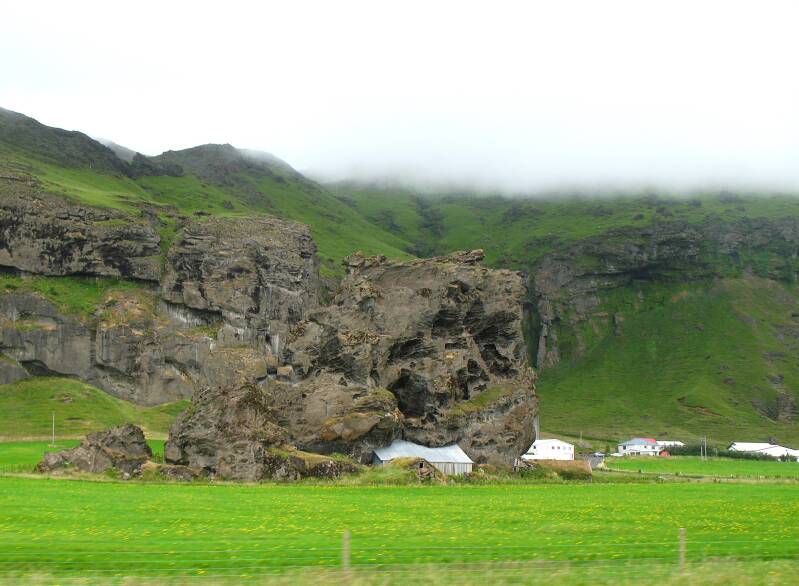
Photo below: the Drangurinn huldufólk dwelling or thin-place, located in Southern Iceland, the Drangurinn itself being the massive rock formation in the centre of the image, although it is somewhat camouflaged against the cliffs behind. Note the barn-like structure built into one of the caves in the rock formation. As can be seen, the rock formation is of unusual appearance, and of impressive size. I have discussed other caves in Iceland elsewhere.
Iceland also has many sites associated with what we would call trolls, elves and beings of the faerie realm. The word "elf" is somewhat hard to try and explain. In Icelandic, an elf is known as álfur. I have gone into the etymology of this word in much detail elsewhere, and have given examples, nevertheless, the name still confuses me, as do the illusive beings that bear the name. In Norse tradition, the elves are associated with the ancestors, and with the dead, but I do not think that they necessarily were thought of as the souls of the passed, not in the strictest sense, even though they are connected to them. The Norse gods, the main, most known gods, also share what seems often to be a close connection with elves. The term "elf" seems sometimes used as a name for divine beings, and not always in a more particular sense. These beings are often associated with light and with spiritual power, whilst the huldufólk in Iceland refers to otherworldly humans that might, for example, perhaps be called "elves" in other areas, but it seems that Icelandic tradition generally applies álfur to divine spirit beings more in the sense of mythological or primordial time.
Nevertheless, I do not really understand the application of the word álfur in a complete sense. For example in Iceland there are places that bare the name of álfakirkja - "elf church", rock formations that are associated with elves, by name, although the name in this context may be referring to the sacred kind of entities connected to these places, and to that they are sacred places to them, and does not necessarily mean that "elf" in this context was not being applied to the huldufólk. The fact that these rock formations are sometimes considered as "elf churches", does to me seem to imply that they were sacred animistic sites, connected to the elves in some way, and perhaps not of the same spiritual system and trajectory that gives us the Icelandic sagas, and the more typically Viking understanding of Gods and the Norse World - but this is speculative, perhaps goddesses like Freyr were honoured at these elf churches, but again, this is speculation - these sites remain very mysterious, and we ought to respect them.
One example of what one might term an álfakirkja, which I have visited, or rather, been past in a car, is known as Drangurinn, located close to Drangshlíð, close to the southern coast of Iceland. From what I understand of the stories of this place however, it seems that this was more a dwelling of the elves or huldufólk. I cannot find many original sources (in Icelandic) regarding the legends of this site, but I do feel in some way that it having perhaps been specifically a dwelling of the Hidden Folk/huldufólk that the place and mythology does give the "vibe" of it being a sacred site, associated with a pre-Norse indigenous people who lived there, and again there are some compelling similarities between the huldufólk and the Good People of Goidelic tradition, for example, and with earlier groups in Iceland having likely been linked to the Gaels, this is interesting. An Icelandic source about this site, is the article Drangurinn í Drangshlíð on the Sagnir af Suðurlandi website. Icelandic sources I have noticed, tend to associate this site with huldufólk and not to my knowledge with álfar. The huldufólk are described as having helped farm animals and as friendly with Icelanders in our realm, and were also respected by the Icelanders in our realm.
This blog post is written in honour of the álfar, huldufólk, tröll and of the primary Norse gods, and to all who I love.
Add comment
Comments