

Written & published by Linden Alexander Pentecost, published on the 21st of August 2026, the photo in this article was also taken by me. This article/blog post is unrelated to any and all of my other publications, and no AI was used, and it was published in the UK. This blog post discusses initially Nordic languages in a general way and then moves onto Iceland specifically, future blog posts on this website will discuss other aspects of this picture. This blog post contains 2219 words.
My journey into Nordic languages, began with the realisation that Nordic languages were importantly connected to Scotland. I was already learning and speaking Gaelic, and had originally no interest in Germanic languages, until this realisation about Norse in Scotland. I then learned a little about Norn, Icelandic, and Faroese, and found that Norwegian also particularly appealed to me, and felt somehow "right", whilst I found Swedish to have a beautiful written elegance, and to be beautiful in music; somehow holy. Icelandic and Faroese felt fascinating, connected to the Goidelic-world and to English, and to the Norse language in Britain, in profound ways. In photos of Iceland, with captions in Icelandic, I saw a part of the same linguistic universe that I felt in relation to say the Orkney Islands and their wild seas, and the Outer Hebrides with their green fields going down to the Ocean.
The first Nordic-speaking country I had visited was Iceland. I spoke enough of the language to use it, by memory around noun-cases was kind of vague and did not cover anything like all of them. The vibe of Iceland felt to me connected to Western Scotland, and to Greenland (see my blog post before this one on this website regarding Greenland & Scotland). I liked Iceland, it felt romantic, but it was in many respects the vibe of Iceland, something present there, and in Scotland, rather than it being that Iceland was more beautiful than other places I had been to. It was however uniquely beautiful.
By the time I was on Barra, in September when I was 18, I was speaking Danish and listening to Danish chav music, or had been earlier when I was 18, so I had interacted with all the main official Nordic languages today: Icelandic, Faroese, Norwegian, Swedish and Danish. I was also pretty familiar with Norn (the Norse languages spoken in Scotland), and with Old Norse. But I was also aware of some of the minority North-Germanic languages, such as Elfdalian, spoken in a part of Dalarna in Southern Sweden; Trøndersk, spoken in Trøndelag in central Norway; Jämtlandic, spoken in central Sweden, the Salten dialect of Norwegian, spoken around the Saltfjorden in Northern Norway, and I was also aware of Bondska, the Nordic language spoken on the shores of the Baltic, and in the river valleys, in Northern Sweden.
With Bondska, I initially learned that year only of the Skellefteå, Burträsk and Kalix Bondska languages, particularly as I had gone through Kalix only a few months before going to Barra, having had no idea at the time that Bondska was a language. When in Norway and Sweden around a month and a half before going to Barra, I also did not know much about Northern Norwegian dialects, having only been briefly introduced to them by someone I met in Nordland.
Icelandic, or Íslenska, originally spelled as Ízlenska, is a language of often softer consonants, voiced dental fricatives, like the "th" in English "this" and "thing", gutteral g and k sounds, like the Scottish Gaelic broad gh and ch, and also possessing pre-aspiration (the h sound before certain word medial consonants), which is also found in Gaelic. Icelandic can however have a noticeably rolled r. These things to me demonstrate the quality of Icelandic, which in many ways, gentle, calming, yet its use of certain intonations can make it also sound very powerful, thundering; whilst to me, when a woman says certain things in Icelandic with certain kinds of tone, it can sound sexy. I feel it as a language of vast valleys on summer nights, when the sun never fully sets, and when the volcanic mountains, with lush green lower slopes, gently seem to flow, to the sounds of a waterfall, and of nesting birds. Icelandic also makes me think of flat landscapes of dried lava flows, covered in moss, the warmth of the sun, and cliffs in the distance, towering like giants, and reminding me of the vibe invoked in the 1950s film version of Jules Verne's Journey to the Centre of the Earth, in which Icelandic is also spoken.
There is a specific reason why I think of the giant, namely that I stayed in a place in Iceland, in view of a mountain known as the Lómagnúpur. This mountain, the Lómagnúpur, is mentioned in Njálls Saga, wherein Flosi Þorgeirson sleeps at Lómagnúpur mountain. In a dream, Flosi Þorgeirson encounters a giant, coming out of the mountain of Lómagnúpur, and prophecising the deaths of some of his men. In modern times, although perhaps with some older origin, the mountain giant, in Icelandic: Bergrisi, associated especially with the mountain giant of Lómagnúpur, is also one of Iceland's "four guardian Landvættir" (Land Wights). The bergrisi , or in particular the bergrisi of Lómagnupur is one of these four guardians, and is thought of as the guardian of the southern part of Iceland, with the idea that the bergrisi at Lómagnúpur watches south towards the sea, guarding Iceland. Between Lómagnúpur and the sea are rivers and lava fields, I stayed in one of these areas once. It was quite alarming to know that the eruption at Eyjafjallajökull relatively recently, had caused a large river entering the sea on the south coast to basically change its course, although I do not remember precisely where this river was in relation to Lómagnúpur.
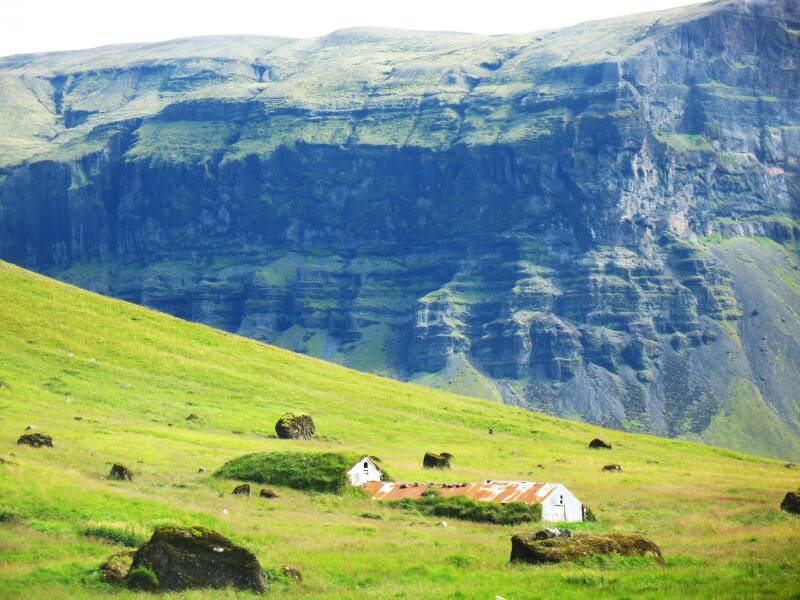
Photo below: some cliffs in Southern Iceland, if I remember rightly, pretty close to Lómagnúpur and as a part of the same system of south-facing cliffs, close to the outflow of the Vatnajökull Glacier. Indeed the landscape below makes one think of giants and of beings connected to the rocks and mountains. The grassy slope in the foreground shows something of Iceland's beautiful summer colours.
The other three guardian Landvættir of Iceland, are the Dreki - "dragon" in the east, the Gammur - a kind of eagle, or a griffin, guards the north of Iceland, whilst the Bull, the Griðungur, guards the west of Iceland. I do not really know anything about these other specific Landvættir, but I know about the legends of worms/wyrms in parts of Iceland, though these are not necessarily "dragons" in the sense our modern culture may understand. I do not yet know much about the other three guardian Landvættir.
"Giants" in Norse tradition can be known by different names, are are not necessarily the same types of beings. One of the most common Icelandic terms is jötunn - often thought to mean something like "eater", but in the name bergrisi we see the word risi being used. Not all of these groups of giants were the same. The term tröll - "troll", can also be applied to "giants", but I do not believe that tröll meant originally a specific type of being, although it may well sometimes describe specific groups of beings, and this can sometimes include "giants".
I have discussed more on the etymology of the word "troll" elsewhere, but here I will discuss different things, for example, that we can see another aspect to the word's meaning and etymology in the Icelandic word trylla - which means "to enchant", but also "to thrill", "to fascinate" or "to delight". In a sense, perhaps something like the "lure of polyamory" can be considered as connected to "troll magic". Just as witches are often associated with polyamorous-type frolicking with horned fertility entities, often simply called "The Devil" in later folklore. Even if polyamorous fornications are not to my knowledge explicitly mentioned in the folklore stories I know like this - I feel it is certainly implied. Whilst polyamory was not the norm in the Norse period, I personally believe that those referred to as tröll in Iceland likely have some connection to pre-Norse peoples, and when they were "physically" in this World, perhaps they did practice a more open form of sexuality. Certainly it does seem implied that female tröll would take Icelandic men as their husbands, which implies a certain promiscuousness, but not polyamory directly.
In Iceland, one of the older terms for "witchcraft" is tröllskapur. This indicates how the word "troll" was not only thought of in terms of being a specific type of being, but rather with a form of magic and enchantment, associated with certain groups of beings, but something which ordinary people could also tap into. This is not to say however that the original meaning of tröllskapur. described something quite akin to how we use the word "witchcraft" today.
In the Pite Bondska language of Northern Sweden, people use the term trölla to refer to beings that in many senses more akin to elves, and this seems to be a specific example of applying the creators, or original holders of this "troll magic", to a specific group of beings.
Another interesting word in Pite Bondska, which sadly I cannot remember at this current time, is a word that means something like a "spook", but more generally it refers to something that is just out of place, in an eerie way. One of my Pite Bondska-speaking friends, told me that when she was younger, her dad talked about such things.
Personally, I do not consider myself a Norse pagan in the traditional sense, because I just don't really identify with the idea of calling myself that, nor do I necessarily feel it is totally me to connect with the main Norse gods. But trolls, and giants, do I think represent earlier undercurrents of spirituality, and I feel that I do more profoundly connect to them. Like several other writers on Norse paganism have implied, to work with gods and goddesses can be communal, ritual, a system that makes sense and is ideal for our current linguistic and mythological reality.
But not all of us fit into that spectrum. And, like several other writers of Norse paganism have implied, working with giants and trolls, and beings that might come under those categories, can be much more personal. These beings, it would seem are innumerable. And unlike the main Norse gods perhaps, it is often necessarily to find them, and to feel them properly, by going to the edge of our realm, where their realm feels most close.
I have personally experienced this in Norway and on the Isle of Tiree for example, although these similar and likely I think connected beings were known generally as a foidhneir or as a ciuthach on Tiree. But, I do feel that perhaps both the Norse and the Gaels were referring to connected groups of ancient ancestors, by different names. I have also written a lot elsewhere about how these mythological and linguistic currents between say Tiree and Iceland might relate to cultures that are technically "pre-Norse" and more to do with the "giants", and "trolls" and "Finns" than being to do with the Vikings themselves.
The other thing about connecting to "giants" and "trolls" spiritually, as other writers have implied also, and also from my experience, it feels in many ways more personal. Whereas Baldr and Thor are main gods associated with the power over certain elements in this linguistic reality, giants are numerous, guardians, connected to particular mountains, caves and places. So if you work with one of them, it is not really akin to worship or a worldview, it's more like a friendship or mutual understanding. You can "feel" it when you're in their area, even see it, because it can feel as though your eyes glitch out or are unable to completely process certain rock formations or features, almost like you just can't quite focus on them for some reason. It feels like trying to look at something five dimensional, with eyes that can only see something that is three dimensional, and there is a certain feeling of sensory overload from the eyes, and an innate feeling that there is something "right there" that you just can't directly look at.
This is of course, just my experience of it, and furthermore, such places are often dangerous, and if you believe in these things like I do, then you'll understand that what I refer to as these beings, can be dangerous and deserve our respect. Pagan writers on these topics likewise may explain how these forces are all unique, and how they contain within them the full spectrum of friendly or unfriendly towards people, just as people display these spectrums of attitudes towards nature. Generally, being cautious, self aware, knowing when to turn back, and most of all: empathy, are all important things here.
I hope that this blog post was good to read, thank you! It is dedicated to the beings and ancestors herein mentioned, and to empathy for all.
Add comment
Comments