

Written & published by Linden Alexander Pentecost, the photo was also taken by myself, the author. No AI was used in this publication, this publication was published in the UK and is unrelated to and separate from any and all of my other publications. This blog post contains 1943 words.
If you go to the town of Bowness on Lake Windermere in Cumbria, you will be walking into what can be described as a modern tourist park. Bowness is the Cumbrian equivalent of Vegas (no, they are not that similar though). Most people who come to Cumbria will have heard of Beatrix Potter, the writer who created stories about animals. Wordsworth was a famous poet, also known today as connected to the Lake Windermere area. And by and large, that's about as deep, and as thorough as the history goes. But - if you are interested in history, you will no doubt come across things like "Cumbria was a Viking land", and "The Vikings came to Cumbria and gave us most of our names". If you look further back you will find things like "Cumbria was originally Welsh-speaking, and this language was called Cumbric".
Do you want to know the problem with this picture? Not only is most of the subject of the Lake District's history overwhelmed by Beatrix Potter and by English-language frameworks, stories and artwork, most of which is often disconnected from our indigenous history - but furthermore, the actual history, what I just wrote about the Vikings and the Welsh - well, that isn't really accurate either, in a lot of ways. Which is frustrating and irritating for anyone who wants to try to connect to the indigenous history in Cumbria.
So, you go to Lake Windermere. The most famous bits of imaginative creative work, by Beatrix Potter, were entirely fictional stories, made up. If you look into the folklore of Lake Windermere you will hear about little beings called Tizzie-Whizies. They also, were made up. You might hear legends of beings called dregpikes, said to live in Cumbrian lakes. These, again, seem to have been made up, fabricated. The reports of a so-called being called "Bownessie" in Lake Windermere, appearing around 2010-2011 - seem to be entirely made up. And I know this personally, because I know someone who's mates apparently created the hoax using various floating objects in the lake. This is embarrassing, especially as I have seen "Bownessie" mentioned in actual paranormal literature. Making stuff up in this way only confuses and misrepresents an already difficult subject.
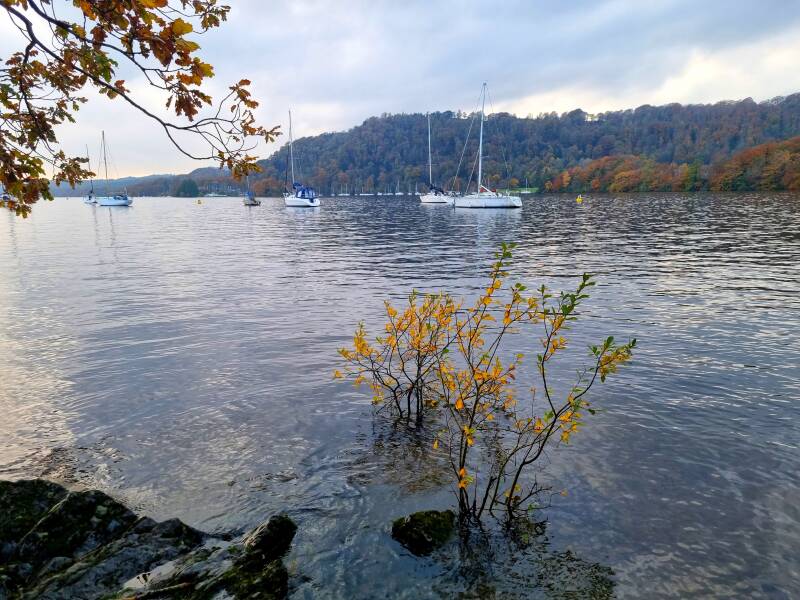
Photo below: Lake Windermere on an autumn day, taken from near Bowness. Bowness. Bowness is supposedly a Viking name, but actually, we can only be sure that it's a Germanic name, because the roots "bow" and "ness" are found in Norse and in Old English. The name Windermere, well, Windermere is supposedly named after a Viking called Vinandr. Such a personal name does exist, but again the chieftain in question may not have been a Viking in the strictest, Norse sense. Again, the underlying root words in the name are found outside of North-Germanic, Norse languages. Often the supposition that such names are Norse is based upon the presence of the masculine genitive ending here as -ar, also found in Cumbria as -er. However, it is perfectly possible I think that speakers of more "classical" Germanic in Cumbria could have shared this genitive -ar/-er with Scandinavian "Old Norse" languages, without their own language needing to be "Norse" in the strictest sense. This genitive usage could also for example have been a part of a formulaic naming system rather than being the normal genitive used in speech. How exactly this -r developed in Norse is itself a bit of a mystery, and I am inclined to think that -r or some kind of -r like sound may have existed as a suffix in pre-Germanic times, rather than simply evolving from an older -s or -z. -r stem nouns are also found throughout "Indo-European", and Etruscan for example uses -r as a plural suffix. Certain North-Caucasian languages also use forms of the "r" phoneme as plural suffixes.
Back to the Vikings. Is there any real evidence of Viking burials, Viking ships, of Vikings - in Cumbria? Actually, not really. Okay, a lot of the place-names in the Lake District have a clear connection to Norse. But are they strictly Norse or Viking? I don't think so. There isn't enough evidence so say objectively that these people were "Vikings" or "Norsemen". Connected to them, yes. But if we look at a lot of the place-names that are supposedly Viking in origin, many of them actually can be equally explained as coming from a form of Old English or Old Anglic. The fact that the place-names share certain similarities to Norse, for example the frequency of the word "Fell", are again, not objective evidence of Viking presence in the strictest sense. Personally I feel that they indicate that the historic Germanic "language(s)" in Cumbria, in many ways paralleled Norse more closely, but were not necessarily "Norse" in the strictest sense. Note also that "fell", Norw. fjell etc may well be equivalent to German Fels - "rock" and Felsen - "rock", with this etymology and that of fjell possibly being, at least in-part, pre-Indo-European. Compare also Proto-Central-Chadic *fyalan - "bank" (1). Many "Norse" words, like "thwaite" could instead be pre-Indo-European substrate words, ultimately. When words like "Rigg" are used as evidence of the "Vikings" - no. "Rigg" can just as easily be explained as a Northern dialectal variant of English "ridge". And what about the runestones?
Yes, Cumbria has examples of both "Norse" and "Anglic" runic inscriptions. But we have to keep in mind that such inscriptions were formulaic, and there is nothing to suggest, no evidence at all, that the language of these prestige, high-culture runic inscriptions was the same language that people actually spoke. In terms of ship burials in Cumbria, an archaeologist called Steve Dickinson has implied that Ivarr the Boneless is buried at a ship burial in North Cumbria. But this is not confirmed and I personally am at least sceptical at the moment. Whilst there is some evidence of Vikings in Cumbria, with a few Viking grave sites found, with no ship burials or Viking ships so far found, these few Viking-style burials seem to represent isolated individuals possessing or at least being connected to "Viking culture". These graves do not in any way indicate that Cumbria ever had a "Viking population" in the strictest sense. The "Viking Crosses" and "Hogback Stones", also used as evidence for "Vikings", could quite easily be born from indigenous traditions and motifs in Northern England and around the Irish Sea, connected in their iconography to the mythologies, spirituality and storytelling of the Vikings, yet by no means are they necessarily Viking in origin. Carvings, such as that of the so-called "Loki". But is this Loki? To say that the stone is Loki sure makes it easy to fit Cumbria's ancient history into a Viking narrative. The only trouble is, that we have no evidence whatsoever that the entity depicted is Loki. The fact that the entity seems bound may well indicate some kind of crossover with Loki, but that is not objective nor empirical evidence that the entity depicted can simply be said to be a "depiction of Loki". I mean, we really have no idea do we? Although I have some thoughts. The Cumwhitton "Viking" burials for example, could equally be representative of a common Germanic "Viking-like" elite society, connected to both Norse and Anglic society, in the same regard to how this central "Viking-like" link can be seen in how the Anglo-Saxons were also expert seamen, with their own boats, not too dissimilar to Norse vessels. From this perspective the Cumwhitton "Viking" burials may represent Germanic royal groups who were connected to the Norse, but who may also have been in Britain long before the Vikings, and who may have been equally connected to the Angles.
The idea that Cumbria is "Viking" seems to be at least to a large degree, to do with a historic re-set and re-imagining of information, rather than being definitive. The "Norse" elements were picked and chosen, whilst other words, Celtic, or pre-Celtic or pre-Germanic, get ignored. The focus is on the Vikings. From the 19th century til the present, the word "Viking" excites us. It gives us a sense of superiority, a connection to these violent, warlike men. And I am really sorry to say this and to burst the bubble, but a fair amount of this, and these headlines around Vikings, seem to be an utter fabrication. Like Beatrix Potter's stories and like Bownessie, our Viking past is to a large degree made up, fabricated, an illusion, like an AI-generated simulation that makes our relationship with Cumbria one of incoherent, misplaced history, one of fantasy writing, and no real visible indigenous connection. The factual information is lost in the illusion. You walk through Bowness, and see the tourists, all visiting this place, The Lake District, presented to them. Tourists also visit the Scottish Highlands, North Wales, Cornwall, where they encounter local history, literature and mythology and language. The difference with Cumbria is that most of this "reality" that tourists encounter is either based upon fiction, or is in part, or in full - a fabrication.
It has taken me 20 or so years to understand what is going on here, but, this is the reality. The Lake District is a re-set land, a land where indigenous tradition and our connection to the ancestors has been almost entirely displaced by a more "safe", typically English, "acceptable" history, planted by writers of fiction, by made up stories, and by misinterpretations of our past.
I am also fed up with how we take this entire history of the Lake District, an entire history for thousands of years, then we stamp the word "Viking" on it, and, well, that's that. The idea of the "Vikings" feeds into our damaged collective past. There are genuine historical connects to Vikings in England, of course, absolutely. But I do not think that the picture is quite as simple as it seems. I think we also like the idea of the Vikings because they represent power. Yes, they are genuinely connected to us Brits, but so are so many other cultures, like the Angles or Welsh, who get virtually no interest whatsoever, despite that the Angles and Welsh were equally capable, and equally powerful and amazing cultures. I feel our modern Anglocentric culture also worships the Vikings, in the same way it worships reels on our phone screens - it gives us dopamine, makes us feel "connected" to something, but is to a large degree a spiritual and mental trap, playing at our own minds and at our lack of known indigenous history, in Cumbria at least, and replacing it with a fake, but attractive mask.
So, let's stop treating Cumbria like some English, outdoor casino complex and adventure park, let's peel back the layers, and see what's really there. I have been doing this for a long time, but doing a lot of publication and work is not equivalent to knowing the absolute objective truth. For that, we are going to have to work together to dismantle the illusions and to look objectively at what we see, without presumption. But the illusion has already broken, and things are changing - slowly.
(1): Central Chadic Vocabulary was reconstructed by Alexander Militarev and Olga Stolbova and can be found on the starlingdb.org website.
Add comment
Comments