

Article written and published by Linden Alexander Pentecost. No AI was used and this article was published in the UK. The artwork was also by myself the author, and is based upon a third-eye dream I had, which I discussed in a different context and with other information in an unrelated publication. This blog post is unrelated to and separate from any and all of my other publications. This blog post contains 935 words. This blog post was edited again and final changes were added at 15:55 on the 13th of July 2026, the other blog post published on this website on the 12/07/2026 was also edited earlier on the 13/07/2026.
In this article or blog post I want to discuss a little on the majesty of how Finnish grammar works, and to relate this to Finland and to the Finnish language in a mystical sense as well with the help of some art I did, inspired by a dream.
The Finnish noun cases are not really just “cases” in the sense that cases exist for Indo-European languages. This is where the idea of a “case” originates, but how these noun stems work in Finnish is not always classifiable as a case system.
For example the suffixes in Finnish do not only express relationships between nouns as objects, indirect objects, ownership etc, they are also used to express things relationships to each other in a much more full way, they are used to express possession in a more general way, they are used to express fine details in the relationships between events and the geometric dimensions of these events, and are used to express finite details about time, becoming, change, state and permanence.
Take for example the sentence on the art below, which reads: Pohjois-Suomessa sijaitseva järvi, jonka mie näin kolmanella silmälläni.
Photo below: a piece of art based on one of my many "third eye" visions and dreams, this dream in particular I also discussed in an unrelated context in an unrelated publication without any art and without contextual focus on Finnish grammar. The art intends to invoke the brightness and haze of the vision, which I believe was a lake in Northern Finland.
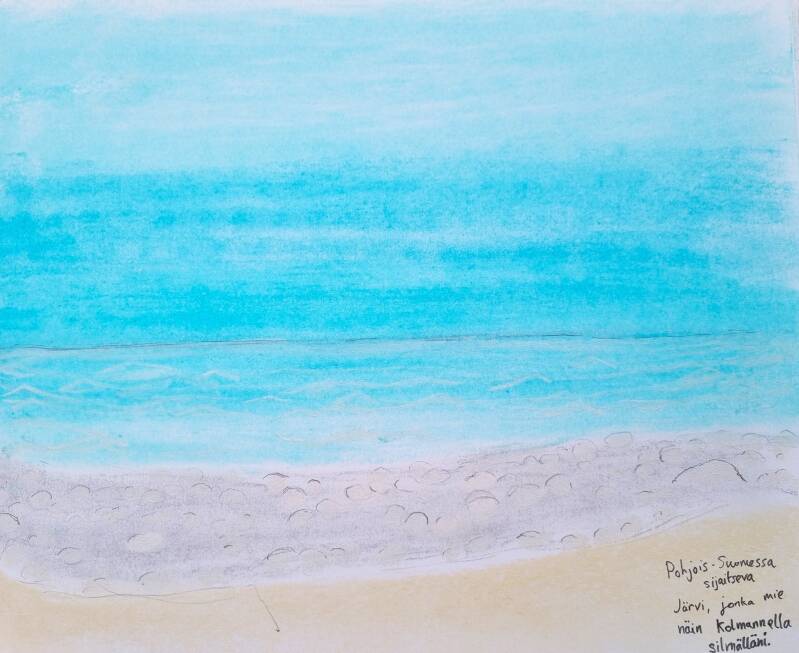
A literally translation would be something like:
“Northern Finland in that is situated lake, of which I saw third-on eye-on-my”.
Or translated into English fully:
“A lake situated in Northern Finland, which I saw with my third eye”
So, pohjois- “Northern”, Suomessa - “in Finland” from Suomi - “Finland”, so Pohjois-Suomessa - “In Northern Finland”. The word sijaitseva means basically “that which is situated”. This is formed of the verb sijaita “to be situated”, plus the suffix -va/-vä which is not a “case” suffix but which forms the word sijaitseva - “that which is situated”. The word järvi means “lake” and is one of the few words in this sentence in its nominative form.
The word jonka is the “genitive” form of joka “that, which”, jonka is used in this context because it is “that which I saw” and because the action is completed the genitive form jonka is used, although it's important to understand that in Finnish the genitive doesn't always act as a genitive in the same way the genitive case in Indo-European languages does.
Mie näin is a Northern Finnish variation of minä näin - “I saw”, not also that the pronoun mie is in the nominative case. Kolmannella means “by third”, which doesn't make sense on its own, but in Finnish the adjectives have to agree with the suffixes of the nouns when the two are linked in a sentence.
Silmä means “eye”, silmällä means “by an eye” or “with an eye” in this context, and silmälläni with the first person possessive suffix -ni means “with my eye” or “by my eye”, thus kolmannella silmälläni means “with my third eye”, a mystical concept.
Another interesting point is that silmäpuoli is one way in Finnish to say “one eyed”, but it literally means “eye-half”. In Irish, the word for “one-eyed” is leath-shúileach, which again literally means “half-eyed” from leath-shúil - “one eye” but literally meaning “half eye” from leath - “half” and súil - “eye”.
It is also interesting of course how the Irish word súil - “eye”, and also Manx Gaelic sooyl and Scottish Gaelic sùil, all meaning “eye”, bare a similarity to Finnish silmä -”eye”. Also clearly the ancient Finns and Gaels or pre-Gaels conceptualised things like eyes as being a set and being in a sense a single entity, so when a person has one eye they explained this as them having “half” of that whole rather than as them having “one” of “two” things.
This whole subject of what makes something a “part” or individual really fascinates me, which is a concept I discuss other aspects of (i.e. snails forming together, Cladh Hàlainn etc in relation to the many other topics in that blog post) in my other blog post published before this one on this website on the 12th of July 2026, which was the first blog post on this new website (the blog post on the page you are on is the second blog post on this new website)
I hope that this article was an interesting and fascinating thing to read, it is dedicated to all Finns. Note that I also discuss mythological/ancestral Finns in Scotland and in a sense - generally, in my unrelated blog post on this website also published a short time ago also on the 12th of July 2026.
Add comment
Comments