

Written and published by Linden Alexander Pentecost on the 12th of July 2026. This blog post is unrelated to and separate from any and all of my other publications, including from the many others wherein other aspects of these these topics and of Tiree are discussed. No AI was used and this blog is published in the UK; this is this website's first blog post (this website being www.runic-serpent-777.co.uk . The photo in this article was also taken by the author & the photo description contains information not in the main text; despite this article covering some previously discussed things (by me) in a new way, it also contains new examples and unique information, as well as being uniquely written and having its own context. More content was added to this blog post at 15:45 PM on the 13th of July 2026. This article or blog post contains 2234 words.
For me there is something a bit odd about the traditionally given history of the Hebrides. The mainstream narrative has largely been that people spoke Pictish, a P-Celtic language akin to Welsh's ancestor language. Then, invasions happened from Ireland, replacing the Pictish language with a form of Middle Irish, then, the Vikings came, and influenced the names and language in the Hebrides and more generally the Gaelic language.
It is simple and also boring. There are also alternatives to it. One thing that has always awed me about the Gaelic language is just how indigenous it is and how connected it is to the landscape and folklore. How could so many unique words, sounds and pagan stories have arrived into Gaelic - if it itself was already used by Christians when Goidelic supposedly came to Scotland?
One could argue that this folklore is of Norse origin. But no it isn't. There are some crossovers with Norse but they could have originated from any time period. Others may argue that these stories and indigenous elements are originally Pictish and come from the P-Celtic speaking Britons. Except there isn't a single piece of evidence for that either. There doesn't actually seem to be any evidence of a Brythonic or P-Celtic “British” language having ever been spoken in the Hebrides.
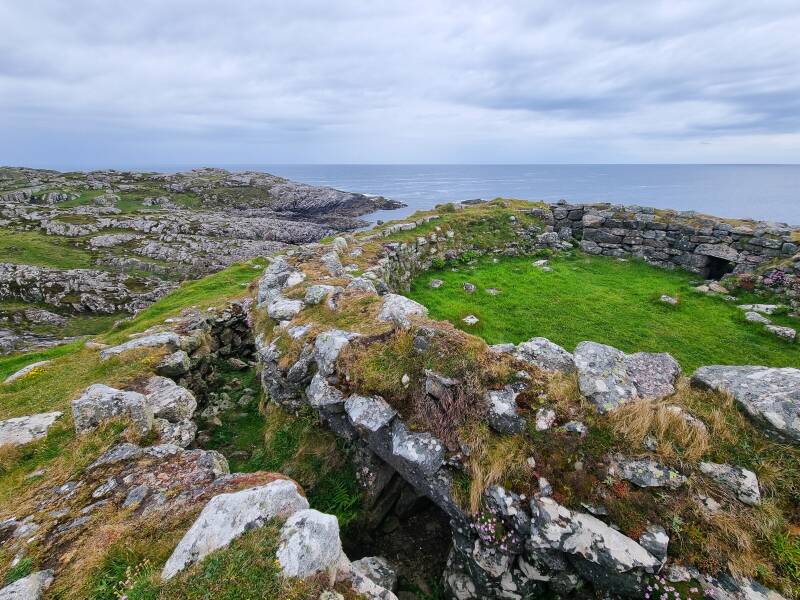
Photo below: Dùn Mór Bhalla or anglicised as "Dun Mor Vaul", literally meaning the "big dun of Vaul", is the most intact of Tiree's broch and dun structures. The name Bhalla/ Vaul is related to the Old Norse word hváll, referring to a kind of hill, although it is also possible that this word and place-name is "pre-Norse" rather than being Norse per-se. The interactions between the Iron Age broch builders and the later Norse is also not well understood, although there are many indications of a kind of continuity between the two cultures, at least in certain areas. My experience here at this broch was quite mystical, especially as a raven seemed to be following me around and "calling" to me whilst in this area. Ravens are associated with Odin, but also are important figures in the belief systems of the northwest Pacific Native Americans, for example. Not far from this site is the "Ringing Stone", which I have published about elsewhere.
So, in some way perhaps these indigenous, pagan elements passed into the Gaelic language or are connected to Gaelic in some way within an earlier, localised indigenous time frame.
One such possibility is that Gaelic has been spoken in Scotland for far longer than previously thought. I believe that this is true to a large extent, but that this original “Gaelic” language may not have fitted together quite as Gaelic does today.
It is also likely that if Gaelic was spoken earlier in time in Scotland, then it would have interacted with or interfaced with other indigenous languages as well.
So when it comes to the interactions between Norse and Gaelic, how do we know that some of the linguistic connections and similarities between the two do not relate to interactions between earlier languages- which then shared a continuity with later peoples, like the Gaels and Vikings?
I would also like to bring up the “Finns” here. Whilst the Vikings are accredited as being the most fearsome warriors of old world Europe, as master sailors and navigators, the Vikings themselves also stand in the shadow of the other cultures who preceded them and who were around them.
One of these peoples or groups of peoples or ancestors can be referred to as the Finns. In many ways, the Finns can be thought of as the magical peoples who sailed the seas, who could transform into fish or sea animals, who may have influenced the earliest facets of Scottish language and mythology long before the Vikings existed. The Finns are doubtless connected deeply to the mythology surrounding selkies and undersea kingdoms, people with magical abilities who were especially known in the Shetland and Orkney islands - although precise accounts of them differ. The Finns in this context are distinct from the Finnish identity and from Finnish people today, but are I think connected in some way.
We praise the Vikings as fearless warriors, and yet the Vikings feared the Finns and their magic. The form of Norse magic, seiðr, may have been more connected to the Sámi and Finns, and to the pre-Norse world, than to the Norse themselves, and the knowledge of seiðr, even among the Norse gods, may have come from the Finns or from their ancestors.
We talk about the Vikings being fierce and powerful seamen, yet the Finns in Scottish mythology were sailors and seamen described with truly magical abilities. They could travel huge distances using just a few oar strokes, and in Shetland they were the only people who had the ability to ride the njuggle, a waterhorse-like being.
I mean, in terms of examples of how important and powerful these Finns were perceived as can be seen in how people generally feared water horse type beings. The Vikings likely also feared these beings or were wary of them. But the Finns? They rode such beings.
Furthermore, the Vikings, but also later Europeans, feared the Finns, especially for their magic. In later years this became a specific worry about taking Finnish men on board boats, for the fear that the Finnish person might cast a spell and change the weather. Similar legends exist regarding some of the Scottish witches, and I think it can be surmised that the two are connected in some way.
Yet there is suggestion even within the Gaelic language of possible deep similarities between certain Finnish and Gaelic words. One such example that I discussed in an unrelated, different recent article also pertaining to Tiree Gaelic and Tiree's witches (one of many unrelated Tiree-related articles this year published by me), is the Tiree Gaelic word tais - meaning "moist or warm", which can be seen as similar to the Proto-Uralic (Finnish-related) root: *kačV - "warmth" (1) and to an Afro-Asiatic root word discussed in the other publication. Note that I have discussed other aspects of the aforementioned topics elsewhere, and many more of these particular cognate examples within Gaelic.
There have been finds on Tiree which are considered Norse, but it can also be said that what is identified as Norse may have older connections to these islands. For example, a "Viking" brooch was found on Tiree, which from what I understand, is intricately designed, having somewhat "serpentine-like" forms which are common in Norse artwork, but which also go back into more ancient times. There is also evidence of Norse or Viking settlement on Tiree, although again, it is not known whether or not the people living on these settlements were mainly newcomers, of if they were mostly people indigenous to these islands who had (re)connected culturally with Scandinavia. When the Vikings came, they would have brought with them new laws, cultural and trade systems as well as a new "naming" system for these things, but to what extent these differed from certain cultural systems and languages already in situ on the islands, is debatable.
The "Finns" as I describe them here do not necessarily connect to the backgrounds of all these indigenous cultures. If the Vikings had pre-Norse ancestors, already speaking a language connected to Norse, in situ in these islands, then, as I have discussed elsewhere, I do wonder if the Gaelic word gall was sometimes applied to these people, in much the same way that several of the broch and dun structures are connected to these people; sometimes translated as "Danes" in the English language, albeit not necessarily in the sense of Norse or Danish people, but perhaps in reference to something much older, which I have discussed elsewhere in relation to language and mythology etc, including in terms of influences in Argyll Gaelic dialects. I also recently discussed in an unrelated article (in which I also discuss yet other things about Tiree Gaelic and other dialects, different from other articles mentioned here, and still one of many discussing these things) how the Gaels of St Kilda may have interacted with "other" populations, and it is perhaps not surprising then that I discovered since then the place-names Laimhrig nam Gall on Hirta and Gob A' Ghaill on Soay which may attest to the presence of "others" in the westernmost parts of St Kilda; and I am not convinced that the goill/"Galls" being referred to here were Norse, rather than earlier peoples, however, I need to find a person who can confirm that gall in the sense of "people from another culture" is the implied meaning in these St Kilda names, before this can be confirmed.
Some of the most unusual magical traditions in the Hebrides invite us to a different spiritual way of thinking, which is in many senses quite profoundly different from our notions of later Celtic religion and spirituality. One thing I would like to discuss briefly are "snail beads" or cnaipein seilcheig in Gaelic. The sacredness and sacred connotations of snails and seashells, and also cthulhonic deities in the Hebrides are something I have discussed a lot elsewhere, including shell middens. There are also shell middens, ancient shell middens, on Tiree for example. These were made by the earliest indigenous cultures on these islands. The snail-beads or cnaipein seilcheig relate to these structures and to this widely previously discussed (by me) aspect of "merging", in my opinion, as cnaipein seilcheig are said to be sacred stones, apparently formed when four or five individual snails come together and "form" themselves into a mass, which then forms a sacred stone, that people used for protection. I am not sure however whether or not the implication on page 221 of The Gaelic Otherworld - John Cregorson Campbell's Superstitions of the Highlands and Islands of Scotland and Witchcraft and Second Sight in the Highlands and Islands, edited by Ronald Black - is that these snails come together to "create" a stone, as in something separate from their bodies, or if the snails themselves form into the stone itself. Either way, there is an implication here of a kind of intimate interaction between multiple snails, which is kind of polyamorous in its implications, and which also implies a merging of energy and soul into a sacred object.
I do wonder if this "coming together" of snails is connected to shell middens in some way, and to those ancient peoples; and if this idea of snails coming together to form an individual mass, an individual sacred being that then becomes a stone being, pertains to these ancient peoples. In a sense, this idea I have discussed in detail elsewhere (including in relation to Tiree) about the polyandrous Attecotti in ancient Scotland, and to this idea of "collective deities" I have also discussed many places elsewhere, may also pertain to this idea of snails coming together, and this also asks us to question how these ancient peoples viewed the concept of the "individual" versus a "collective" spiritual being. A similar concept is in a sense expressed in some Paleolithic, Mesolithic, Neolithic and Bronze Age burial traditions. The concept and magic behind the cnaipein seilcheig certainly seems to imply that there was a concept in the ancient Hebrides - a concept of snails, more Cthulhonic-like beings at least, having the ability to "merge" themselves, or at least aspects of themselves, into a collective energy or being.
A similar idea - which I have also discussed a lot elsewhere, can be seen in how the Cladh Hàlainn mummies found on South Uist were made from parts of multiple individuals made into just two mummies, with one mummy having a jaw bone from a different human than the rest of its skull came from, for example. Note that in my other blog post published on this website on the 12th of July 2026 I also discuss in detail another aspect to this concept in terms of Finnish and Goidelic terms for "one eyed".
I hope that this blog post was a fun read and awakens curiosity in others - it is dedicated to the people of Tiree. Source (1) refers to that the Proto-Uralic form *kačV - "warmth" was reconstructed by Sergei Starostin and can be viewed on the starling.rinet.ru linguistics website.
Add comment
Comments