

Written and published by Linden Alexander Pentecost, and published on the 9th of September 2026. This article/blog post is unrelated to and separate from any and all of my other publications; it was published in the UK, and no AI was used in this publication nor in any of my writings. The photo in this article/blog post was also taken some years ago, by myself the author. This article/blog post contains a total of 1963 words.
Arawakan languages are a large and diverse family of languages spoken in South America, and to some extent in Central America. I have a real passion for South American Indigenous Languages, and whilst I am pretty familiar with those of the Andes, and to some extent others, but there are so many indigenous languages in South America, and my knowledge is naturally limited. There are entire language families that I know virtually nothing about, and in some cases, neither does anyone else. When I heard back in 2018 I think, about the destruction of linguistic and anthropological data after a fire at a museum in Brazil, I felt pretty devastated. At the time I wanted to create some kind of online community for gathering, openly sharing, discussing and working on indigenous South American languages. Such communities exist, but they tend to be hidden behind the veils and to be more privately academic. Which is why I conceived of that idea - because there just isn't enough passion and interest in South American languages in general, data and information about them has been allowed to die, disappear, and this is not only a tragedy, but is also an outright loud insult to those indigenous people of South America who contribute a plethora of knowledge, wisdom and information about a large region of our planet.
Of course there are other reasons, for one, it is difficult to get to parts of South America to do research. But another part of the problem is that the information on these languages is sometimes collected, but not used or made widely available. Even when taking tribal privacy into consideration, I think that the lack of publicly available information on many of these languages does make the situation worse rather than better.
If I was going to live for a thousand years, then I would be able to make a huge difference with this. Generally, people tend to live to around 100, but that's still enough time to make a significant effort towards change in these subjects. I am unlikely to ever live in South America, but I can still do a lot with the resources, intellect (if it can be called that?), and research abilities that I do possess.
The Arawakan languages are divided into northern and southern branches. The northern branch is spoken in parts of the Caribbean, Venezuela, Columbia, Northern Brazil, Guiana, Suriname and French Guiana. The southern branch is spoken in parts of south central Brazil, western Brazil, and in parts of Peru, Bolivia, and to a limited extent in parts of Argentina and Paraguay. Having done quite a lot of research on these and on Andean languages, I feel that Arawakan languages do in many respects provide a cultural and linguistic "corridor" between the Caribbean/Atlantic Ocean, and the Andes. Out of the indigenous language families in South America, the Arawakan languages cover one of the largest geographical ranges.
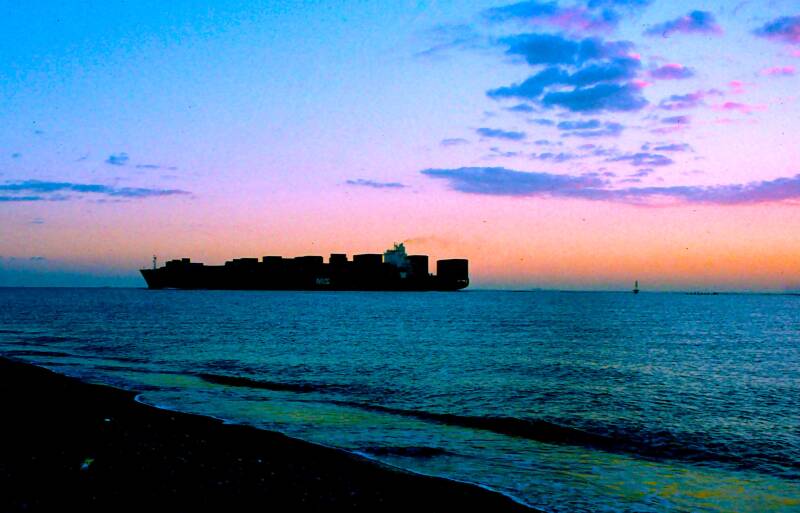
Photo below: The Caribbean Sea, taken some years ago on a beach at sunrise, with a ship (obviously) in view. In Arawak the word for "sea" is bara and the word for "sun" is hadali. I do not know the word for "sunset", but I believe that the image below gives a feel and impression for the kinds of seascapes witnessed and and seen by speakers of Arawak, and invokes the nature of this language and of its inherent sacred reality.
The family is named after the Arawak language, also called Lokono. Arawak or Lokono is a member of the Ta-Arawakan or Caribbean Arawakan grouping of Arawakan languages, some other members of which are Wayuu and Taíno. The Taíno language is famous for having once been the primary indigenous language (bot not the only indigenous language) of the Caribbean Islands. Efforts to revive different dialects of the Taíno language are underway. I do not know precisely how similar Taíno and Arawak are, and Taíno in many senses seems to have fewer phonemes than Arawak, even if some publications tend to give a more simplified definition of Arawak's phonology - although it does also vary from dialect to dialect. I have also heard it implied that Arawak is perhaps the "closest" language to the Taíno language of the Caribbean Islands. The Taíno people in the Caribbean Islands also did not die out, but rather integrated into the Afro-Caribbean communities on these islands. There is also a controversial idea existing within the "Tartaria theory" community, that Afro-Caribbeans are the indigenous people of the Caribbean. Whilst I think there might be something to this theory, I dislike the way in which this theory is sometimes used to imply that Native Americans are not indigenous to the Americas, which is an utterly absurd idea. I can accept the possibility though that there could have been black people in parts of the Americas in ancient times, alongside larger populations that we now refer to as Native Americans. Obviously, this theory is also used sometimes to imply that the Slave Trade didn't happen, which is obviously not true - it did happen. But, that doesn't necessarily mean that all black slaves were from Africa. As I white person I don't really feel it's appropriate to theorise about this much more here. But essentially, I do think it is possible that black people could represent some of the indigenous populations outside of Africa, it being also possible for example that not all, but some of the ancient peoples in ancient Britain could have been black.
It is perhaps possible that there are deeper connections between Afro-Caribbeans and speakers of Arawakan and Cariban languages, which might predate European colonialism in the Americas. But, I don't know. What's interesting to note is that some of these Afro-Caribbean communities ended up speaking the Garifuna Language, rather than speaking so-called "creole" languages (I don't think the word "creole" really fully conveys the status of these languages are their own unique parts of the Germanic and Romance language "continuums"). The Garifuna language is related to the Kalinago language, which is another indigenous Arawakan language, that was spoken in parts of the Caribbean, as well as Taíno. The Garifuna language is technically also an Arawakan language, but it does contain more links or loanwords to European languages, and contains a significant amount of vocabulary from Cariban languages. The Caribs who were present in the Caribbean left a lot of words, but ended up speaking Kalinago. The original Cariban language spoken by these people, may have been close to the Carib or Kalina language of Venezuela. The Cariban languages are a whole other language family, and are not Arawakan languages, but Cariban languages are to a great extent spoken in proximity to northern Arawakan languages. There have been some attempts to connect the Cariban languages to the Je language family, but fundamentally the two language families are just so different from each other, in my opinion.
Arawak or Lokono does have masculine and feminine genders, but these do not work the same way as they do in Indo-European languages. Gender is visible in pronouns though for example, the pronouns in Arawak having standalone emphatic forms, end-point forms, and prefixed forms. For example the first, second and third prefixes are d- or da- for "I", b- or bu- for "you singular", l-, lo- or lu- for "he", and t-, to- or tu- for "she"
Out of the indigenous American languages, Arawak is perhaps not the most difficult for an English speaker. The language has some really beautiful ways of expressing concepts, as well as what appears to be fascinating inherent sound symbolism. The language has some wonderful ways of expressing concepts and meaning. For example the verb aiyuyuto means "to water" (1), which itself seems related to the word yuyuokili - which means "mist", pertaining, perhaps to the way in which moisture brings the life giving substance. Another interesting connection between different Arawak words, is the way in which a word for "wisdom" and "cleverness" is derived from the word for "a song", "a song" being ienihi in Arawak, which is related to ienikoto - "to make wise", and ieniko - "wisdom" or "cleverness". The language also contains some examples of reduplication, for example in the word uwadawada - "fins", I have mentioned other examples elsewhere. The word uwadawada also seems to contain sound symbolism or sacred root language similarly represented in Quechua as wayt'ay - "to swim", in English "water" and "wet", and in Finnish vesi - "water". There are a great many such similarities in Arawak, and I have discussed others extensively elsewhere. Another example which I have not published about before (from what I remember) is Arawak seme - "to be good" or "to be delicate", and seme/semehe - "good spirit", which can be compared to Quechua samay - "breath, spirit", to Finnish sumu - "fog" and perhaps English "same", if there is a higher spiritual teaching of this root, then I think it perhaps relates to the spirit, to breath, to cloud, and to "oneness". Words relating to "time" and "life" also contain an interesting symbolism in Arawak, for example Arawak haika - "peace", and Arawak ika or ikka - "a certain time" or "there was once", compare also Arawak kokke and kakü - "life" or "to live". This shows a similarity to Finnish ikä - "an age", iki - "eternally", aika - "time", and to Japanese ikiru - "to live", iki - "breathing", and also iki - "life" or "alive". Another interesting word is kalekku, a word referring to the spirit of quartz, or to white stones or pebbles used by a medicine man. This word kalekku bares a similarity to Quechua khallki - "cobblestone", and to for example certain words in unrelated, far distant language families, which I have discussed examples of elsewhere.
According to what I understand of source (1), the author indicates that each phoneme in Arawak contains a certain sound symbolism. I have discussed other aspects of this elsewhere, but for example, the author of source (1) explains that the l (L not i) sound is connected to willingness, movement and masculinity. The author of source (1) also connects the sound k(a) is connected to the act of appearing and being present, similarly ka/ga means "there is". Perhaps the symbolism of this sound is also connected to the "time words" in the previous paragraph. The sound f is on the other hand, associated with "aspiration" and a "lightness", and this can also be seen in the most fundamental sense in the Arawak word fa - "will" or "future".
I hope that this blog post was a fun read. The Arawak words in bold were all originally learned or sourced from the book: The Arawak Language of Guiana by C. H. DE GOEJE; the definitions and explanations in this article I have learned, but are to some extent based upon those in the aforementioned source, as well as the word definitions more fundamentally having been backed up by other sources. The comments on the specific sound symbolism of k and f are also only in the aforementioned source, to my knowledge (as well as me having discussed and published about other aspects to this elsewhere).
Add comment
Comments