

Written and published by Linden Alexander Pentecost, on the 15th of October 2026. This blog post/publication is unrelated to and separate from any and all of my other publications, and no AI was used in this publication, and it was published in the UK. Note that: Northern Sámi is an indigenous language from Northern Europe. In terms of my publications on this website only, you can read a more basic introduction to Northern Sámi in my article on this website, titled: On three languages of Troms: Tromsødialekt, N. Sámi & Kven, publ. 30/07/2026, whilst one of my more thorough works on introducing Northern Sámi and certain aspects of it is published on my kielimatka-2-11 website, and is titled: DS1: A new introduction to Northern Sámi; and connected topics, published on the 19/02/20; and I have published much more about Northern Sámi and other things on Lannankieli elsewhere. I have written very very extensively about Finnish elsewhere, too. This article/blog post (on this page) contains a total of 1005 words, and one photo with photo description above, I also took this photo myself.
Anyway, in this blog post I am going to be discussing named for different types of tree in these languages. Unfortunately, information about Lannankieli is not so easily available, and so my comments on specific tree names are more brief, but I do relate it to Meänkieli and to Finnish tree names, and will discuss these in another blog post on this site.
First of all, the Northern Sámi word for "tree" is muorra. Note that the rrin this word is strongly rolled by speakers of certain dialects of Northern Sámi. Other forms of this same root word are found in other Sámi languages, although the word may not be "Uralic", per-se, and only occurs rarely in Uralic languages outside of the Sámi languages. Similar words occur in other, unrelated languages, which I have discussed elsewhere in relation to these Sámi forms.
The Northern Sámi word for a rowan tree is skáhpi. The Lule Sámi word for "rowan tree" is skáhpe, whilst the Southern Sámi word is raavnije, the Southern Sámi form being from a different root - that connected to Norwegian rogn - "rowan". The Inari Sámi language uses the word pihlejâš for this tree, whilst in Skolt Sámi, the word is råʹšnn. The Inari Sámi word must be connected to Finnish pihlaja- "rowan tree", although rauni is a beautiful and more poetic name for a rowan tree in Finnish, Rauni is also used as a title for the Goddess of the Rowan Tree, who in Finnish tradition is considered to be the wife of Ukko, the thunder god. The Sámi name Ravdna is related and is also connected to Rowan trees.
In Finnish tradition, some other trees can also have multiple names. The Scots pine tree, or a pine tree more generally, is known as mänty in Finnish. But the word honka refers specifically to an ancient pine tree that stands out and is significant in some way. Another Finnish word for a "pine tree", or specifically for a Scots pine tree, is petäjä, which is itself related to Northern Sámi beahci. Below are a couple of examples of Finnish sentences I have written to discuss some of these tree names:
1. Nuo hongat ovat korkeimpia asioita koko maisemassa - "those old pines are the highest things in the whole landscape"
nuo - those, plural of tuo - that (distant), hongat - plural of honka, ovat - are, korkeimpia - partitive plural form of korkein, which is the superlative form of korkea - "high", asioita - partitive plural form of asia - "thing",, koko - "all (of)", maisemassa - "in the landscape", inessive form of maisema - "landscape".
2. Syysvärit näkyvät ikivanhoista metsistä - "the autumn colours show (themselves) from the ancient forests"
syysvärit - "autumn colours", from syys- "autumn", värit - "colours", plural of väri, näkyvät - they show (themselves)", plural present tense form of näkyä, ikivanhoista - elative plural form of ikivanha - "ancient", metsistä - elative plural form of metsä - "forest".
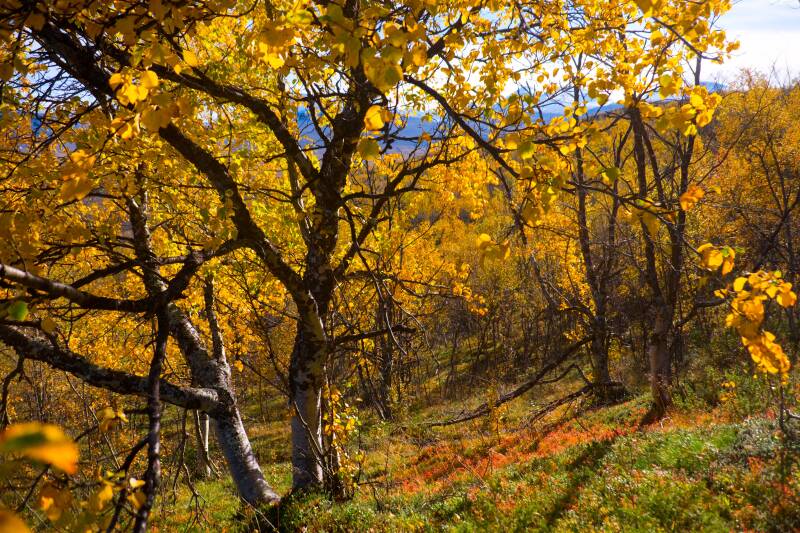
Photo below: beautiful autumn colours on a mountainside above Abisko, this scene reminds me a little of some of the scenes in "The Hobbit" films, it reminds me especially of the scene where Bilbo climbs one of the trees of Mirkwood, to get a view over the landscape of autumn leaves, with beautiful butterflies stirring and flying across the canopies. In fact, if we compare Middle Earth to Europe, Mirkwood, originally known as Greenwood The Great, "might" correspond in some way to the vast forested regions around what is now the Baltic and Northern Scandinavia and Finland. Similarly, the "Iron Hills" to the east of Mirkwood could for example correspond to the magnetite geology of the Kola Peninsula, Magnitogorsk in Southern Urals or Kursk Magnetic Anomaly. And we all know of the mysterious similarities between the Finnish language and Tolkien's Quenya Elvish language. I feel that whatever magic Tolkien was connecting to, one can still feel it, and the same of ancient adventure, in Lapland/Sápmi. Note also that massive magnetite deposits exist around Kiruna and Jellivaara,
In terms of tree names in the Quenya language, I remember that the Quenya word for a "rowan" is farnë (1), whilst the word for a "birch" is hwindë (1). Note that farnë has some interesting similarities to the word "fern" in English, and for example to German Farn. Could this perhaps be because the shape of the leaves of the rowan or mountain ash tree resemble those of a fern? Tolkien's languages incorporated a lot of real world sound symbolism and etymologies, and I have written about a great many examples of these elsewhere. Of course the general word for "tree" in Quenya, is alda (1), whereas one of the two name for "autumn" is lassewinta (1), which literally means "leaf blowing" (1).
(1) - Quenya words, at eldamo.org
Add comment
Comments