

Written & published by Linden Alexander Pentecost on the 18th of October 2026, this blog post is unrelated to and separate from any and all of my publications, including those unrelated others (including recently) wherein I have discussed other aspects to the topics discussed here. This blog post was published in the UK and no AI was used, this blog post contains 1309 words. I also created the art included in this blog post/article. Note I have also discussed Dr Who in other ways in unrelated, separate blog posts, here and elsewhere.
I have discussed much more other stuff on The Neverending Story elsewhere, including with other written content about it published elsewhere recently by me. In this article/blog post on this page I look at specific things not discussed before, some of which relate to my other recent, separate publications. The Neverending Story is such an amazing book, because not only is the book we can buy, titled "The Neverending Story", but the book is also "about" a book called The Neverending Story, and The Neverending Story is a metaphor for the whole of creation. It emphasises this idea that reality is created by sequence, words and language, and so the book is a metaphor for the whole universe. The Auryn symbol on the front is a metaphor for the final spiritual key, and it sits upon the book as both a guardian and a gateway to the eternal.
The book urges us to remember the magic that mankind has always known. And most importantly, it asks us to remember who we really are, the mother and father as the origin of all life.
Bastian's decision to read the book is a choice that seems predetermined. Some of Bastian's fellows chase Bastian, and he hides in a bookstore. Then, against the logic of his mind and the routine and acceptance that life requires of him, he makes the sudden decision to change direction, and so he steals the book, and skips school to read it.
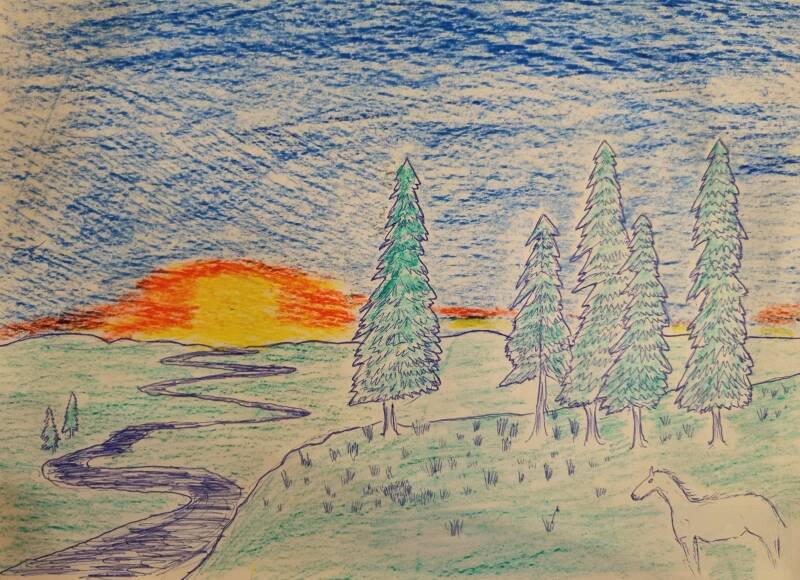
Photo below: some art I created, with council of another, depicting a "horse on the steppe". The horse could be Artex. The horse could also be a horse in Kyrgyzstan or in North America, but regardless, the horse in the art below, for me, represents freedom and choice. The art also invokes for me the same feelings of The Neverending Story and of Atreyu and Artex travelling across Fantastica on their holy quest. This art is meaningful to me.
This "stealing" is metaphorically akin to how Dr Who is said to have stolen the Tardis. But these forms of theft are not typical. They ultimately represent the choice to "leave" the prescribed linear causality and the acceptance of life. Both characters are choosing loneliness and uncertainty over comfort and causality. But it is this very act to choose loneliness which causes an utter shattering in the matrix. These small acts of denial and theft are both done in order to overcome the true darkness of causality and meaninglessness.
And I think that if we consider the possibility that God or the Great Spirit granted these people incredible importance - it is not because they followed the rules, it is because they were the only ones who broke the rules but for the right reasons.
Bastian stole the book not out of a need to "have" or possess the book. He stole the book because it called to him, needed him, and he made the choice to open it. His choice represented a pure choice, to choose what he truly felt was right, even if it seemed illogical, even if it meant being alone, and entering a world where his only guide was his internal compass.
In the film, when Atreyu, Bastian's dream-self reaches the Ivory Tower, Cairon expresses how he needs Atreyu the warrior.
Atreyu states that he is the only Atreyu of the Plains People and begins to walk away. But Cairon says "if you really are the Atreyu we sent for, would you be willing to go on a quest?" This question cuts right to the heart of it. It implies that even though Atreyu doesn't look like a warrior, even if he represents the innocent true unburdened self, "if" he is true to that name - with Atreyu being derived from Sanskrit Atra - a deity name, and Sanskrit ātreya - "descended from Atri", with "Atri" being a devourer of darkness and of ignorance, in other words - if he truly is the vanquisher of darkness that they sent for, would he be willing to go on a quest? Compare also Hebrew עֲטָרָה, Atara - "crown".
Cairon then continues: "the only advice I can give you is this - you must leave all your weapons behind".
This is a statement of, if you really do want to swallow darkness and to save the world, then you can't do it with weapons. They wont help you. Your vulnerable truest self is the ONLY thing that you can take with you on this quest. It doesn't matter how illogical or scary that might seem, but your tears, your emotional truth and your truest feelings and vulnerabilities are the only way, and the path is narrow.
Cairon them presents him with the symbol of the Auryn, which will guide and protect him. This is akin to Dr Who opening the Tardis as the gateway to all of creation. Or akin to Bastian seeing the Auryn on the book cover, and then choosing to open the book.
Just as the Tardis is female, so the Auryn symbol is connected to the Childlike Empress, and he who wears the Auryn symbol represents the Empress. This can also be interpreted as: he who chooses rightly, and opens the door to time and creation through his own heart, is protected by the goddess figure, his twin flame, his true love, and by wearing the Auryn, or operating the Tardis, the character represents the divine woman, the divine mother and the divine female of their own spirit.
This can also be interpreted as - if a man truly wants to know the truth and to explore creation, then he must represent the divine feminine. His actions must be heroic and brave, yet those actions must align to the realisation that everything in creation is from the heart of the mother, and is the body and life force of the Empress.
Within the story, it is “The Nothing” which “devours” in the most notable sense, but it might be argued that Atreyu is in turn the opposite of “The Nothing”, with Atreyu being the devourer of darkness, the devourer of illusion, and who is ultimately I think symbolic of truth and freedom. Atreyu’s horse is named Artex, and Atreyu and Artex together are like two spirit friends, across all of time. When Artex dies in the book and film (contrary to popular belief, the horse did not actually die during filming) - but when Artex dies (temporarily), in the story, Atreyu is utterly devastated. The name Artex can be compared with Old Persian aṛta - “truth”, but more generally can be said to mean something like “unchanging, divine truth”, “cosmic order” and "righteousness".
The Auryn itself has an interesting name, resembling both Latin aurum - "gold" (note that the Empress is sometimes called the "Golden Eyed Commander of Wishes"), whilst a connection with Greek ourobóros - "tail devouring" seems implied from the nature of the symbol itself. Similarities to many other words can also be seen, including to Finnish aurinko - "sun", for example.
I hope that this blog post was an interesting read:) It is dedicated to all who are inspired to find true freedom, true truth and true love.
Add comment
Comments